
Obsidian fracture guide
What Ripple Marks on Broken Obsidian Mean
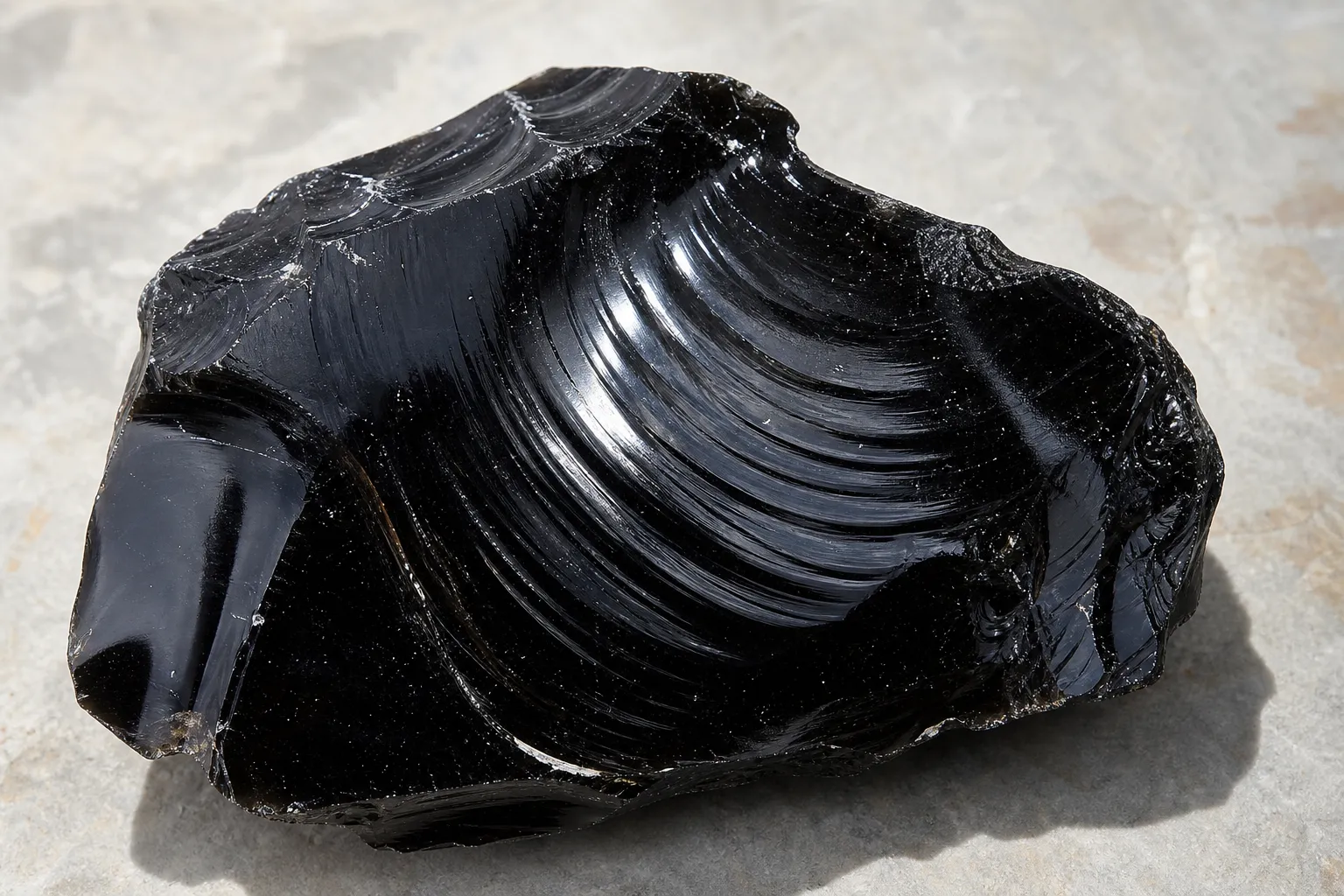
Ripple marks on obsidian usually mean the piece broke with a conchoidal fracture: a curved, shell-like break pattern common in brittle volcanic glass. On a broken obsidian surface, those marks may look like waves, ribs, rings, or curved arcs spreading across a glossy face.
The short reading is this: if the surface is glassy, curved, and rippled, the marks most likely record how the obsidian fractured. They are not growth rings, fossils, carved symbols, or proof that the piece is rare, old, natural, or valuable.
upward
Read the full overview first
Use the broader guide first if you need the full scope before this page.
The visible clue: a glassy break with curved waves
A broken obsidian face often looks different from a polished outside surface. Instead of a rounded tumbled shine or a weathered outer skin, the broken area may show a glossy, curved plane with shallow ridges.
Collectors might describe these features as:
- ripple marks
- wave-like ridges
- curved arcs
- ribs or rings
- shell-like lines
- obsidian fracture ripples
The geology term for this pattern is conchoidal fracture. “Conchoidal” means shell-like. It describes a break that curves through a brittle material instead of splitting along flat, regular cleavage planes.
Obsidian is volcanic glass, not a crystal with neat cleavage directions. When force passes through it, the crack can move in curved fronts. Those fronts may leave visible undulations on the broken face, almost as if a small wave moved through the glass and stopped there.
These are not the same as sedimentary ripple marks, which form when water or wind moves sand or sediment. On obsidian, the “ripples” are fracture marks on a broken glassy surface.
What the ripples can tell you
Conchoidal ripple marks can be useful, but their meaning is narrow. They help explain the break, not the entire identity or history of the stone.
When looking at a broken obsidian surface, check a few visible cues:
-
Is the surface glassy rather than grainy?
Fresh obsidian breaks often show a glass-like luster. A dull, sugary, or gritty surface may point to another material or to weathering that makes the fracture harder to read.
-
Are the marks curved rather than straight scratches?
Conchoidal fracture tends to leave arcs, waves, or concentric-looking ridges. Straight parallel lines may be saw marks, polishing lines, scratches, or abrasion.
-
Do the arcs seem to spread from one side or point?
Some broken faces show ripples radiating away from the area where force entered the piece. The starting area may be near an edge, chip, or small raised feature.
-
Is there a rounded swelling near the start of the break?
A bulb of percussion is a rounded feature that can appear near the point where a fracture began. It is often discussed in stone fracture and toolmaking contexts, but for a collector it should be treated as one clue, not a complete conclusion.
If several features line up—a glossy broken face, curved arcs, wave-like ridges, and sharp glassy edges—the practical meaning is likely: this piece fractured like brittle volcanic glass.
What ripple marks do not prove
Ripple marks on obsidian are easy to overread because they look dramatic. The safer interpretation is more limited.
Conchoidal fracture in obsidian does not prove that:
- the piece is definitely natural obsidian
- the piece is antique
- the stone came from a specific volcanic source
- it was intentionally shaped as a tool
- it is rare or valuable
- it belongs to a special variety
- the pattern carries a fixed symbolic message
- one exact break event can be reconstructed from a photo
The biggest limit is authenticity. Obsidian commonly shows conchoidal fracture, but conchoidal fracture is not unique to obsidian. Similar curved breaks can appear in manufactured glass and in other brittle silica-rich materials such as flint, chert, quartz, jasper, and related stones.
The same caution applies to age and human workmanship. A broken obsidian surface with ripple marks may resemble examples shown in toolmaking or archaeology discussions. That does not make a collector piece an artifact. Intentional shaping, use-wear, transport damage, and age require more context than a few curved lines on a broken face.
Ripple marks vs. flow bands, scratches, and polishing lines
A common confusion comes from using one word—“lines”—for several different features. On obsidian, lines can come from fracture, internal flow texture, surface wear, polishing, sawing, or later damage.
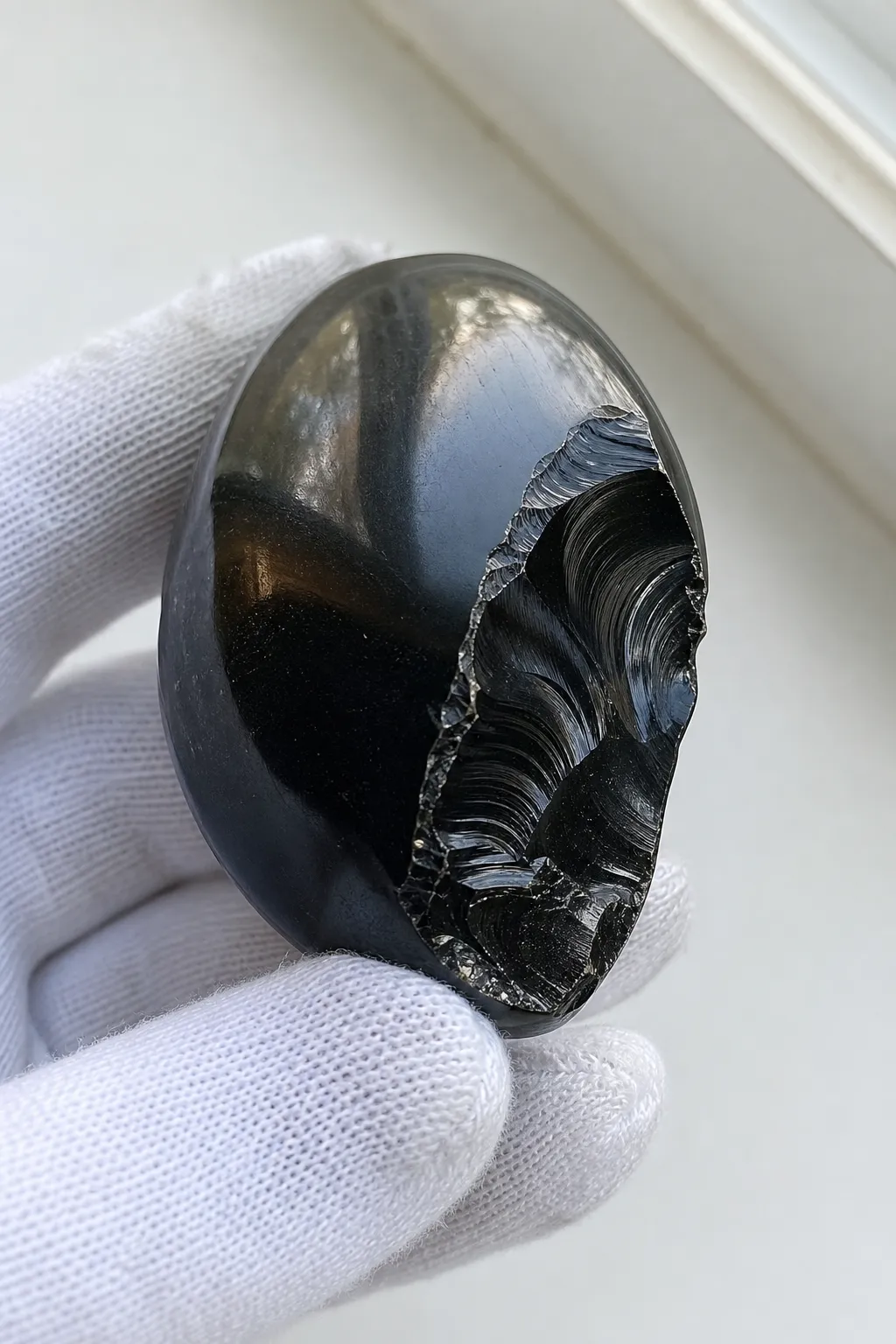
A polished tumbled stone can make this harder. The outer surface may be rounded and shiny from polishing, while a chipped edge exposes a fresh broken face. Ripple marks are most meaningful on the broken glassy area, not on the polished exterior.
Weathering can also soften the pattern. Older exposed surfaces may look duller, scratched, hydrated, or abraded. The fracture may still be present, but the arcs may not be as crisp as they would be on a fresh break.
Why the pattern may be imperfect
Textbook examples of conchoidal fracture often show clean, elegant curves. Real collector pieces are usually messier.
A broken obsidian face may show only partial arcs. The ridges may be shallow, interrupted, crowded near one edge, or visible only when light hits from a low angle. The surface may be partly conchoidal and partly irregular. Less perfect versions are sometimes described as subconchoidal: still curved or shell-like, but not as cleanly developed.
That variation does not automatically make the piece suspicious. Breakage depends on the stone’s shape, the direction of force, pre-existing cracks, inclusions, weathered surfaces, and what the stone struck against. A small chip on a tumbled piece may show only a few curved lines. A larger broken face may show a more obvious fan of waves.
The key is not perfection. The key is the combination: glassy material, a curved fracture surface, and ripple-like ridges that fit a brittle break.
If you are trying to confirm obsidian
Ripple marks can support a collector-level visual check, but they should not be the only test.
Compare the broken area with the rest of the piece:
- Obsidian usually looks glassy on a fresh break.
- Chipped edges may be sharp and thin.
- Black obsidian may show brown, gray, smoky, or translucent edges under strong light, depending on thickness and type.
- Snowflake, mahogany, sheen, or rainbow obsidian may have additional visual traits, while still breaking in a glassy, curved way.
- Manufactured glass can also be glassy and conchoidal, so context matters.
If the question affects value, artifact status, locality, or whether a piece is natural rather than manufactured, casual inspection is not enough. The ripple marks help name the fracture style, but they do not settle those larger questions by themselves.
Handling sharp broken obsidian edges
The practical next step may be care, not naming. Broken obsidian can have very sharp glass-like edges, including tiny chips that are hard to see.
Handle a broken piece deliberately:
- Do not slide your finger along the broken edge to “feel” the ripples.
- Avoid pressing on thin flakes or projecting chips.
- Hold the piece by a stable, rounded, or polished area when possible.
- Keep broken specimens away from soft fabric pouches that can tear.
- Store sharp pieces so they do not scratch other stones in a tray or box.
- If small fragments are present, clean the display area carefully rather than brushing them aside by hand.
A chipped display piece does not need special drama, but it does need respect as broken glassy material. The edges matter more than the exact name of every ridge.
Physical meaning vs. symbolic meaning
Some collectors attach personal or symbolic meaning to broken stones, unusual patterns, or unexpected marks. That is a personal or cultural layer, not a physical reading of the fracture.
Physically, ripple marks on broken obsidian mean the material fractured in a curved, glass-like way. They do not show a fixed spiritual outcome, a change in someone’s wellbeing, or a specific message. If you choose to keep the piece because the pattern feels meaningful to you, that is separate from what the break marks can demonstrate.
For identification, stay with the visible feature: a glossy broken obsidian surface with curved arcs is best understood as conchoidal fracture.
Quick collector answer
If your broken obsidian-looking piece has ripple marks, waves, or shell-like arcs on the broken face, they most likely show conchoidal fracture in volcanic glass. The marks record how the break traveled through the material.
They can support the idea that you are looking at a brittle glassy fracture surface, but they do not prove authenticity, age, value, source, or intentional working. Handle the piece as sharp glassy stone, and use the ripple marks as one clue—not the whole story.