Collector label guide
How to Label Obsidian When the Locality Is Unknown
A glassy black surface, a curved fracture edge, or a faint sheen can help you describe an obsidian specimen. It cannot fill in a missing place of origin.
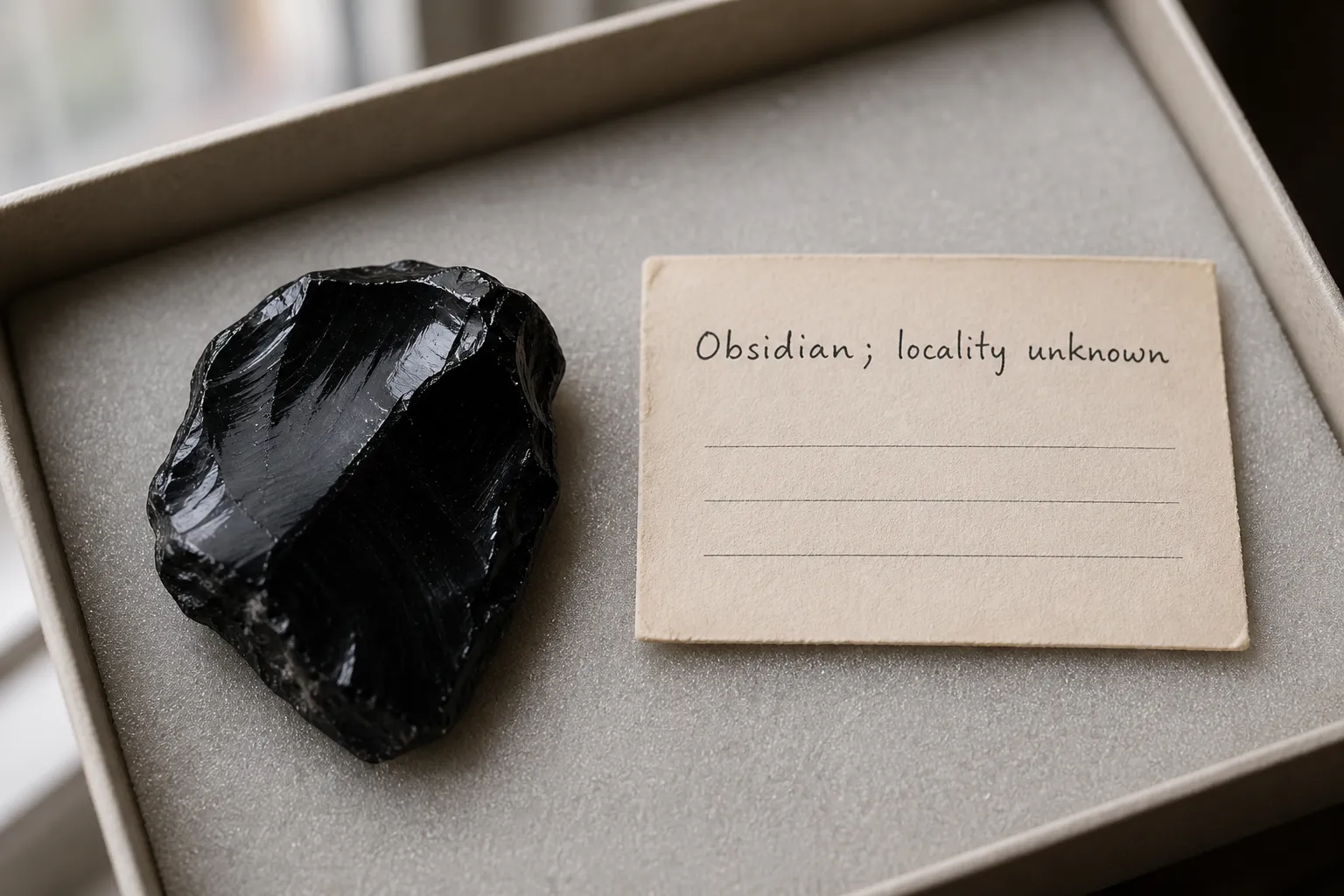
The most honest unknown locality obsidian label names the material, records visible traits, and leaves the locality unresolved. A practical label can read: “Obsidian, locality unknown” or “Obsidian; provenance unknown; black glassy specimen; seller locality unverified.” If you are not fully sure the piece is obsidian, soften that part too: “Possible obsidian; locality not recorded.”
Keep the fields separate: known facts, visual observations, seller claims, and missing provenance should not be blended into one confident origin story.
upward
Start with the broader guide
Use the broader guide first if you need the full scope before this page.
A Simple Label Format
For a tray, storage box, or display card, the label does not need to be elaborate. It needs to show what is known and what is not known.
Compact example
Obsidian; black glassy specimen; locality unknown; acquired from estate lot, 2026.
If a seller gave a location but you have no supporting record, do not turn that claim into a settled fact. Use wording like:
Obsidian; seller stated “Mexico”; locality unverified; black glassy surface with conchoidal-looking fracture; acquired 2026.
That preserves the clue without making it stronger than the evidence. It also prevents a common collecting problem: a vague seller locality gets copied from label to label until it looks more certain than it ever was.
If the piece has a market variety name, keep that separate from place:
Rainbow sheen obsidian; locality unknown; variety name based on visible sheen, not verified provenance.
Appearance can support a description. It cannot recover a lost origin by itself.
What to Write When You Know Only Part of the Story
An unlabeled obsidian specimen may come with fragments of information: a seller name, an old box label, a handwritten tag, a verbal claim, or a variety name. Give each fragment its proper weight.
Documented facts
- “Acquired from [seller or shop name], 2026.”
- “Old handwritten tag reads ‘Oregon,’ not otherwise verified.”
- “Gift from family collection; original locality not recorded.”
- “Purchased as ‘Apache tear’; source unverified.”
Visible observations
- “Black glassy luster.”
- “Brown-red color patches.”
- “Gray-white rounded inclusions.”
- “Iridescent sheen visible under angled light.”
- “Sharp edge; handle with care.”
Missing record wording
- “Locality unknown.”
- “Provenance unknown.”
- “Locality not recorded.”
- “Source unverified.”
- “Seller locality unverified.”
These phrases are not formal certification language. They are practical collector wording. They show that the locality is not known from your current records, without implying that the specimen has been authenticated, appraised, or traced.
When the material identification is also uncertain, avoid stacking certainty on top of uncertainty. Instead of “Obsidian from Glass Buttes,” write:
Possible obsidian; black volcanic-glass-like specimen; locality unknown.
That gives the next person a cleaner starting point.
Separate Variety Name, Locality, and Provenance
Collectors often use variety names because they are convenient. Snowflake obsidian, mahogany obsidian, rainbow obsidian, gold sheen obsidian, and Apache tear are names you may see in shops or collections. Those names can describe appearance or market grouping, but they should not be treated as verified origin.
Variety name
What does this piece look like, or how was it sold?
Locality
Where did this piece come from?
Provenance
What record connects this piece to that source or ownership history?
Those are different label fields. Mixing them makes the label less useful.
If a stone has gray-white spots against black glass, you might write:
Snowflake-type obsidian; locality unknown; gray-white rounded inclusions visible; acquired without source record.
That is better than assigning a famous locality because you have seen similar pieces online. The visible trait supports the descriptive name. It does not prove where the volcanic glass formed or where it was collected.
The same applies to sheen. A bright reflection may justify a collector description such as:
Gold sheen obsidian; locality not recorded; variety name based on visible sheen under angled light.
If the seller gave a source, but you cannot check it, write the source as a claim:
Sold as gold sheen obsidian from [claimed locality]; seller locality unverified.
The claim remains available for future research, without becoming a fact on the label.
When Not to Guess a Locality
Do not add a locality because the specimen resembles a known source, because a shop name sounds regional, or because a variety is commonly associated with one place. Those clues may be interesting. They are not the same as a record.
The common mistake is upgrading visual similarity into origin. A black, glossy, conchoidal-looking piece may resemble many obsidian specimens. A banded or sheened surface may look familiar. But an obsidian locality unknown at purchase usually stays unknown unless stronger records appear.
A second mistake is copying a sales title into the locality field. If a piece was sold under a phrase like “Mexican obsidian” or “Oregon obsidian,” your note should show whether that wording came with documentation or was only part of the listing. Without supporting records, write:
Obsidian; sold as “[seller phrase]”; source unverified.
A third mistake is treating an old tag as complete proof. Old tags are useful clues, especially when they travel with a collection, but a vague or damaged tag still needs cautious wording. If the tag says only “Nevada?” or “Mexico,” keep the uncertainty visible:
Obsidian; old tag reads “Nevada?”; locality not verified from current records.
A clear unknown provenance specimen label is more useful than a confident but unsupported place name.
A Short Decision Path
Use this quick path when you are holding the piece and deciding what to write.
If you know the locality from a reliable record
Write the locality, then keep the record with the specimen or in your notes.
If a seller claimed a locality but you cannot verify it
Write the claim as a claim: “seller locality unverified” or “sold as from [place].”
If there is no locality information at all
Write “locality unknown” or “locality not recorded.”
If you know the variety name but not the source
Write the variety name separately: “mahogany obsidian; locality unknown.”
If you are unsure the piece is obsidian
Write “possible obsidian” or “volcanic-glass-like specimen.”
If the label is for sale, trade, or donation
Make the uncertainty more visible, not less. A buyer, recipient, or future cataloger should not have to guess which details are documented and which are visual impressions.
For a compact label, use one line:
Obsidian, locality unknown; black glassy specimen; acquired 2026.
For a fuller label, use three lines:
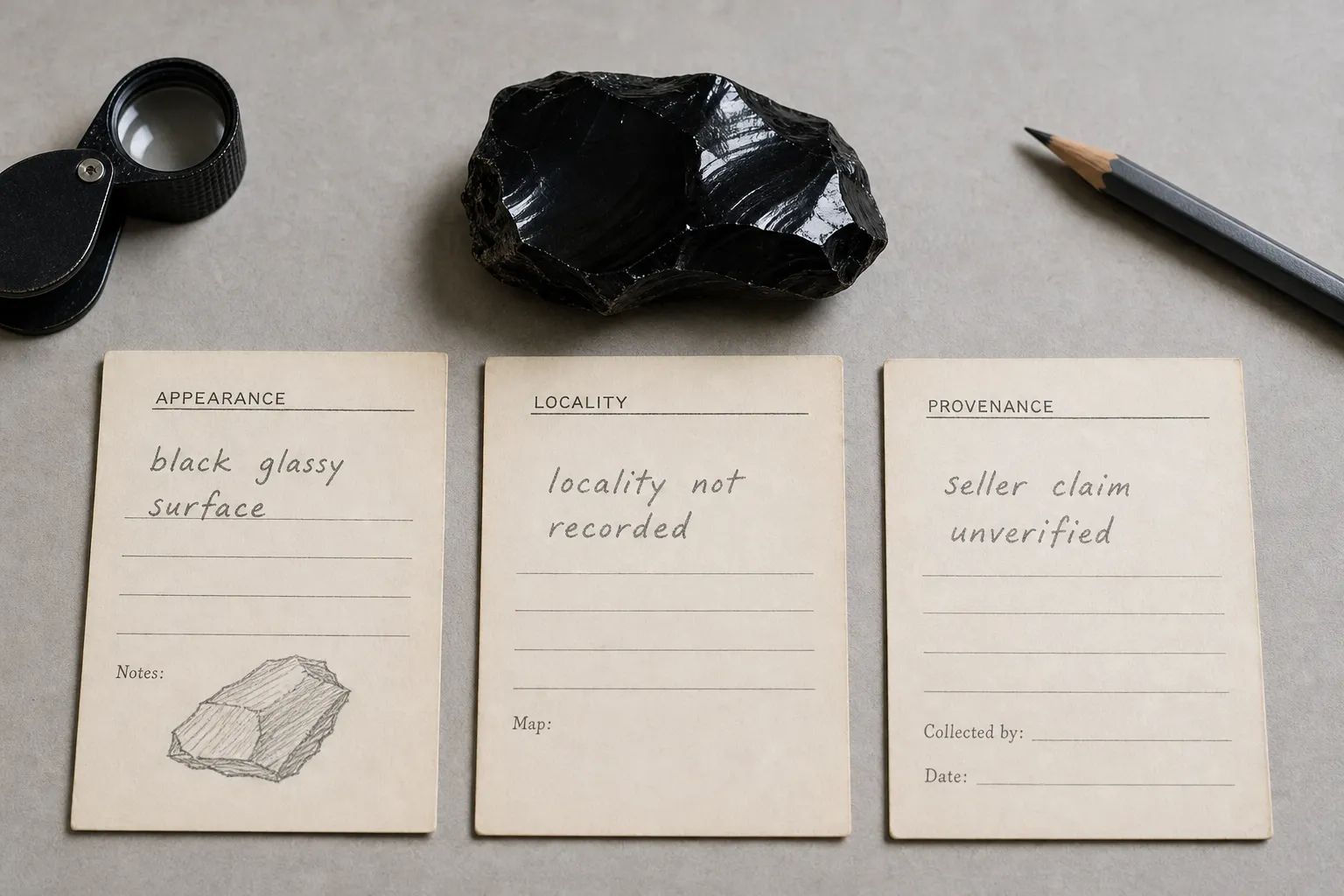
Material: Obsidian
Description: Black glassy surface, sharp fracture edge
Locality/record: Provenance unknown; seller locality unverified
That format works because it does not ask one phrase to do everything.
What a Label Cannot Do
A label can organize what you know. It cannot make unknown information known.
For this page, the available source set does not support a formal public standard for collector wording, and it does not support a reliable method for recovering obsidian locality from appearance alone. The guidance here is practical collector wording, not a geological sourcing method, value conclusion, or institutional cataloging rule.
If the origin matters for research, donation, sale, or a serious collection record, keep more than the label. Save photos, receipts, old tags, messages, and acquisition notes with the specimen. For higher-stakes identification, ask a qualified geologist, mineral specialist, museum professional, or experienced lapidary to review the piece and the paperwork together. Even then, documentation usually carries more weight than a loose visual match.
For everyday collecting, the responsible choice is simpler: name the visible traits, preserve the acquisition note, and leave the locality open when the locality is not recorded.
Practical Label Examples
Plain unknown locality label
Obsidian; locality unknown; black glassy specimen; acquired from mixed collection, 2026.
Use this when you have no source claim and the material identification is reasonably comfortable from the collection context.
More cautious material label
Possible obsidian; locality not recorded; black glassy surface with curved fracture pattern; acquired without documentation.
Use this when the piece looks like obsidian but you do not want the label to sound settled.
Seller claim preserved
Obsidian; sold as from [place]; seller locality unverified; acquired 2026.
Use this when the seller gave a locality but you do not have a supporting record.
Variety name separated from source
Snowflake-type obsidian; locality unknown; gray-white inclusions visible; variety wording based on appearance.
Use this when a variety name is useful but the place of origin is missing.
Old tag but uncertain record
Obsidian; old tag reads “[place]”; provenance unknown beyond tag; acquired from estate lot.
Use this when you want to preserve a clue without turning it into full certainty.
Keep the Unknown Useful
An unknown locality label is not a failure. It is a clean record of the specimen’s current state of knowledge. For obsidian with no locality, the best label does not decorate the gap with a famous source or a confident market phrase. It keeps the gap visible.
Write what you can inspect: color, sheen, inclusions, fracture edge, polish, size, and condition. Write what you can document: seller, date, old tag, gift source, or collection lot. Then write the missing part plainly: locality unknown, provenance unknown, or locality not recorded.
That kind of label remains useful because it leaves room for better evidence later. The specimen can sit in your collection honestly, with its glassy luster described and its origin still open.