Collector listing check
How to Check Obsidian Size, Weight, and Scale in Online Listings
A glossy black surface, a curved fracture edge, or a bright sheen can make an obsidian piece look larger online than it will feel in hand. For an obsidian size and weight listing, start with the seller-stated numbers first: length, width, height, and weight. Then compare those numbers with any ruler photo, hand photo, scale photo, or packaging note.
The limit is straightforward: a listing can tell you what the seller says, but a photo does not verify mass on its own. Treat the measurements as seller-stated until the piece is measured directly.
A good listing gives exact weight and dimensions, uses units that match the buyer market, and separates item size from packed shipping size when both are shown.
upward
Read the full overview first
Use the broader guide first if you need the full scope before this page.
First check
- Read the written dimensions before judging the photos.
- Confirm the weight includes a clear unit.
- Separate item measurements from parcel measurements.
- Use scale photos as context, not proof of weight.
Read the Measurement Fields Before the Photos
The most useful part of an obsidian size listing is usually the measurement block, not the most dramatic image. Look for three dimensions, not just one: length, width, and height, or the closest equivalent for the shape being sold.
For a palm stone, tower, sphere, carving, rough chunk, or slab, the useful question changes with the shape.
Palm stone or worry stone
Check first: length, width, thickness.
A thin piece can look broad but feel light.
Tower or point
Check first: height and base width.
Height alone can hide a narrow base.
Sphere
Check first: diameter and weight.
Diameter gives scale; weight affects hand feel.
Rough piece
Check first: widest points and weight.
Irregular edges make single measurements less useful.
Slab or cabochon
Check first: length, width, thickness.
Thickness changes weight and mounting use.
If the seller gives only “small,” “large,” “palm size,” or “display size,” the listing is vague. Those words may work as shop language, but they do not replace obsidian dimensions. A “large” tumbled stone in one shop may be smaller than a “medium” piece somewhere else.
Weight needs the same care. An obsidian weight listing should state ounces, pounds, grams, or kilograms clearly. A number without a unit is not enough. A listing that says “weight: 120” leaves the buyer guessing; 120 grams and 120 ounces are very different objects.
Use Scale Photos as Comparison, Not Proof
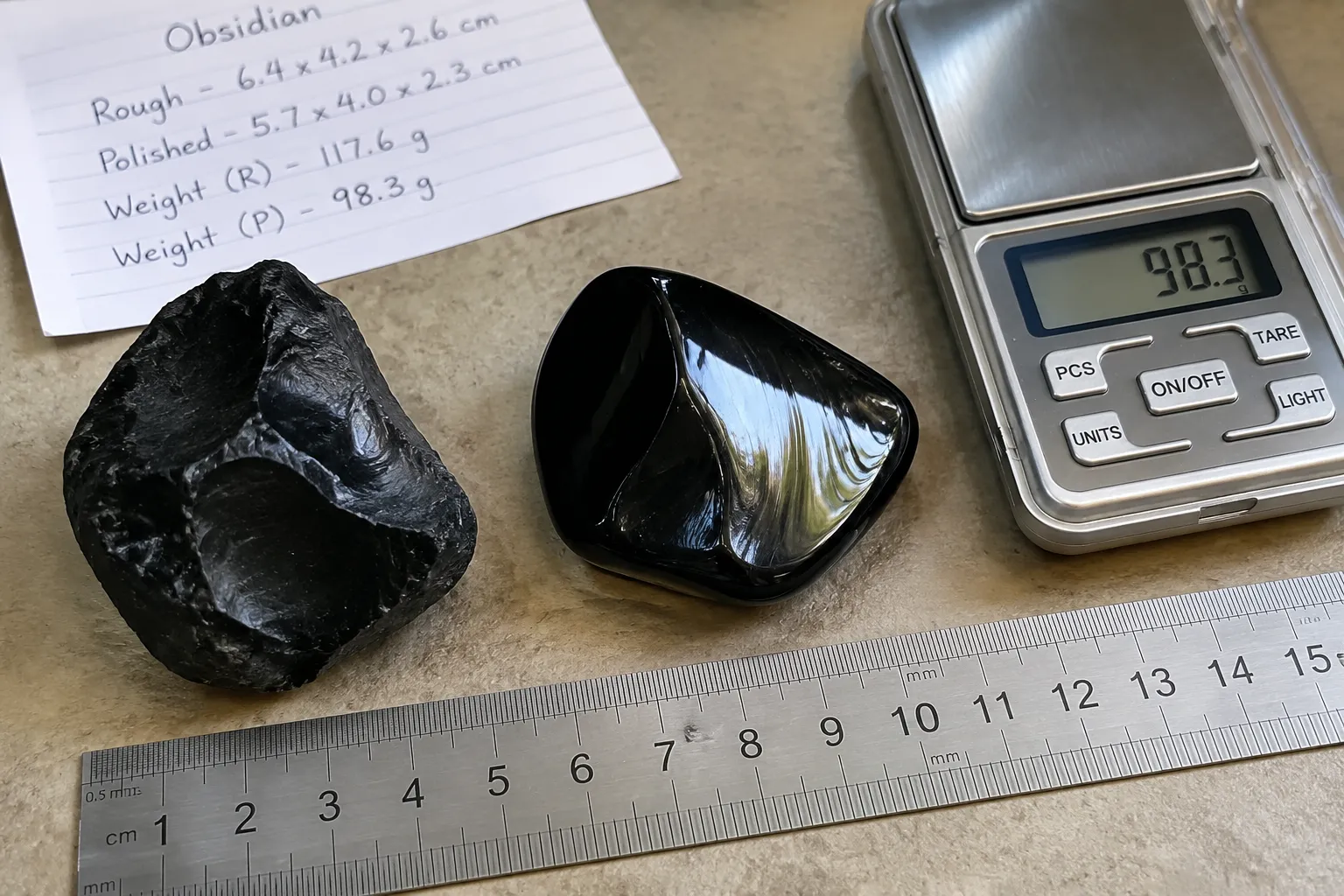
An obsidian scale photo helps when it shows the specimen beside a ruler, coin, hand, display stand, or common object. It gives visual context. It does not prove the true weight of the stone.
Photos compress depth, change apparent size through lens angle, and can make a polished black surface hard to read. A rounded piece photographed close to the camera may look heavier than it is. A flat slab photographed from above may look substantial while being thin. A tower can look tall and still have a small footprint.
Use scale photos to ask better questions.
A scale photo works best when it supports the written measurements. If the listing states a 70 mm sphere and the photo shows a sphere beside a ruler, the two pieces of information reinforce each other. If the photo looks inconsistent with the stated dimensions, do not try to resolve it from the image alone. Ask for a fresh ruler photo or a clear measurement update.
Photo-only weight estimation should be treated cautiously. The available material supports listing conventions and shipping workflows, not a method for determining a stone’s mass from an image. Weight depends on volume and material density; a picture does not supply enough reliable information for that.
Separate Stone Size From Shipping Size
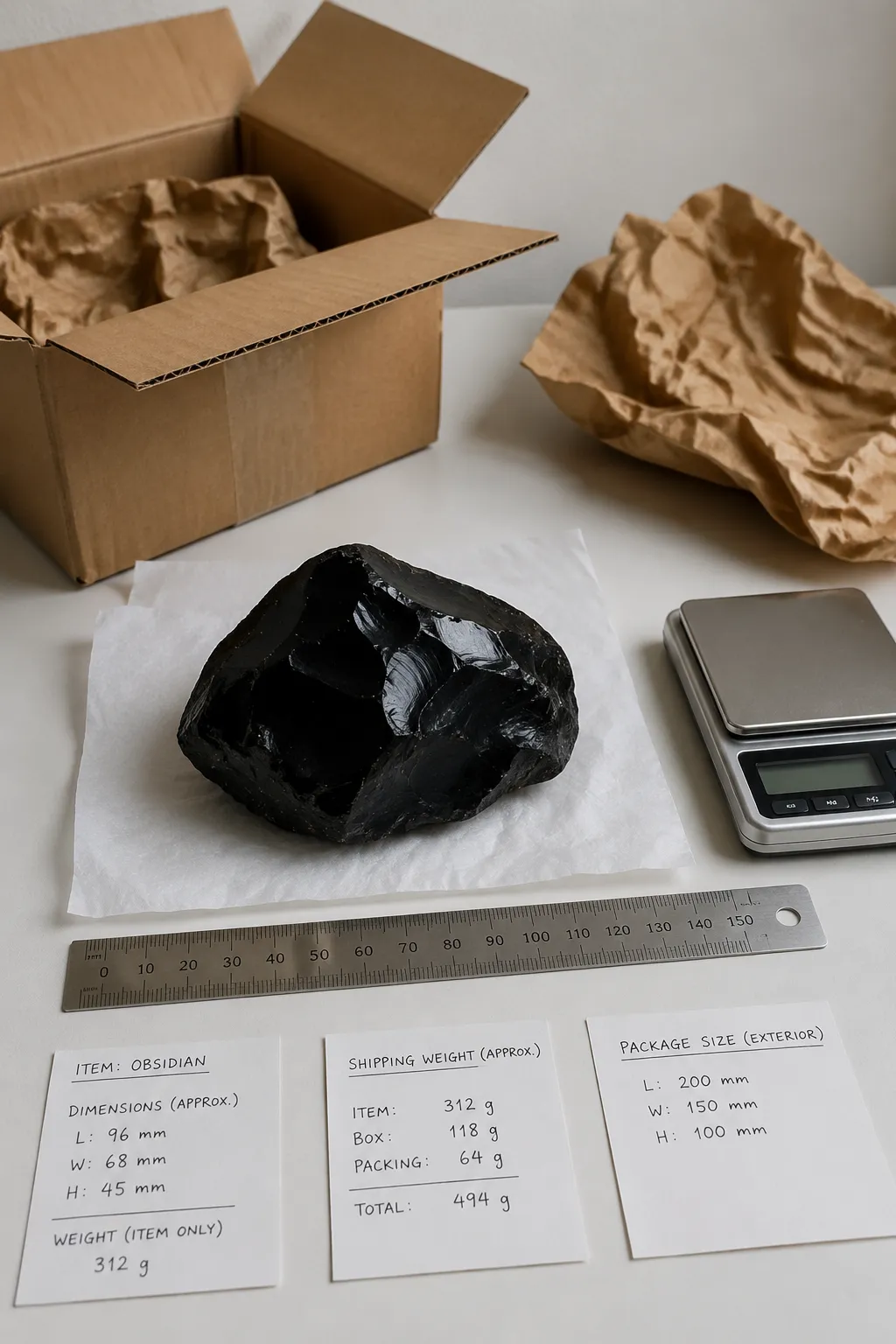
Packed and unpacked measurements are easy to confuse. For a collector, unpacked measurement is the size of the obsidian piece itself. For shipping, packed measurement is the size and weight of the parcel after wrapping, padding, box, and label are included.
Both can appear in online listing workflows. E-commerce listing guidance commonly treats weight and dimensions as standard item-spec fields, and some marketplace or shipping systems use those values to calculate shipping options. That does not make the packed box size a mineral trait. It is a shipping convention.
Item dimensions
Usually the stone itself. Use this field to estimate display, hand feel, and storage fit.
Product dimensions
Often the object, but check context. Compare it with photos and shape.
Package dimensions
Box or parcel size. Use it to understand shipping, not specimen scale.
Shipping weight
Stone plus packing material. This is not the same as stone weight.
Net weight or item weight
Usually the piece itself. This is the best field for a hand-feel estimate.
If a listing gives “packed size” but not the actual obsidian dimensions, you still do not know how large the specimen is. A small polished piece in a padded gift box may have larger packed dimensions than a bigger rough piece wrapped simply.
This matters when buying obsidian online because the use of the piece changes what matters most. A display shelf may need exact height. A pendant cabochon needs thickness and face size. A palm stone buyer may care more about hand feel, so weight and thickness matter as much as length.
Check Whether the Units Fit Your Market
Units that match buyer market expectations reduce mistakes. A seller may use inches and ounces, centimeters and grams, or millimeters for smaller polished pieces. None of those units is wrong by itself. The problem is mixed or missing units.
For obsidian, common listing patterns include millimeters for cabochons, beads, and small carvings, where the mistake is misreading them as centimeters. Centimeters often appear for palm stones, towers, and medium pieces, but buyers used to inches may need conversion. Inches are common for display pieces, carvings, and towers, though fractions can be rounded loosely.
Grams are useful for comparing hand feel in tumbled stones, spheres, and palm stones. Kilograms or pounds often appear for larger specimens or bulk lots, where the important question is whether the weight is per piece or for the total lot.
When a listing mixes systems, convert before deciding. A 50 mm piece is 5 cm, or just under 2 inches. A 300 g stone is about 10.6 ounces. Small conversion mistakes can make a piece seem more substantial than it is.
Also check whether the measurement is per piece, per lot, or for a representative sample. A listing for “one obsidian tumble” may show a range, such as 20-30 mm, because the buyer receives one similar piece rather than the photographed individual. That is different from a one-of-one specimen with exact weight and dimensions.
If the listing shows a named variety, such as snowflake obsidian, rainbow obsidian, mahogany obsidian, or gold sheen obsidian, do not let the variety name distract from scale. Variety names describe visible traits or seller categories; they do not replace measurement.
What to Ask When the Listing Is Vague
A vague seller measurement does not always mean the stone is poor. It does mean the listing is incomplete for a careful buyer. Ask for the missing field that affects your decision, rather than asking a broad question like “How big is it?”
Useful seller questions
- “Can you provide the length, width, and thickness of the actual piece?”
- “Is the listed weight the stone only, or the packed shipping weight?”
- “Can you show the piece beside a ruler in the same photo?”
- “Is the weight per item or for the full lot?”
- “Are the dimensions approximate or measured from this exact specimen?”
For irregular rough obsidian, ask how the seller measured it. The widest point may not describe how it sits on a shelf. A rough piece with a sharp fracture edge may also need careful handling and storage, so dimensions are not only about display size; they also help you decide how the piece will fit in a tray, wrap, or stand.
If the seller cannot provide exact measurements, decide whether the uncertainty is acceptable for the purchase. For a low-stakes decorative piece, a range may be enough. For a fitted stand, jewelry setting, collection drawer, or matched pair, vague sizing is usually not enough.
A Quick Listing Check Before You Buy
Before buying obsidian online, run the listing through a short check.
- Does it give length, width, and height or thickness?
- Does it give the item weight with a clear unit?
- Does it distinguish item weight from shipping weight?
- Does it separate packed and unpacked measurements when both appear?
- Do the photos support the written numbers?
- Does any scale photo show a ruler or object close enough to be useful?
- Is the listing for the exact piece shown, or a similar piece from a lot?
- Are the units clear enough for your market?
The strongest listing is not the one with the prettiest surface photo. It is the one where the written dimensions, weight, and visual scale agree closely enough for the decision you are making.
Where the Evidence Stops
Public listing guidance is useful for understanding how sellers should present product fields: exact weight, exact dimensions, market-appropriate units, and shipping-related measurements. It does not verify a particular obsidian specimen. The geology side is also limited for this question; obsidian is volcanic glass, and weight relates to volume and density, but that does not let a buyer calculate true weight from a product photo alone.
So the practical rule is narrow. Use the listing fields first, use the scale photo as supporting context, and ask for clarification when packed size, item size, shipping weight, or specimen weight are mixed together. The visible surface may help you judge sheen, color banding, polish, and general shape. The numbers tell you scale only if they belong to the actual piece.