Buyer label check
How to Read Obsidian Seller Labels Before You Buy
A useful obsidian label tells you what the seller is claiming. It does not prove the claim by itself.
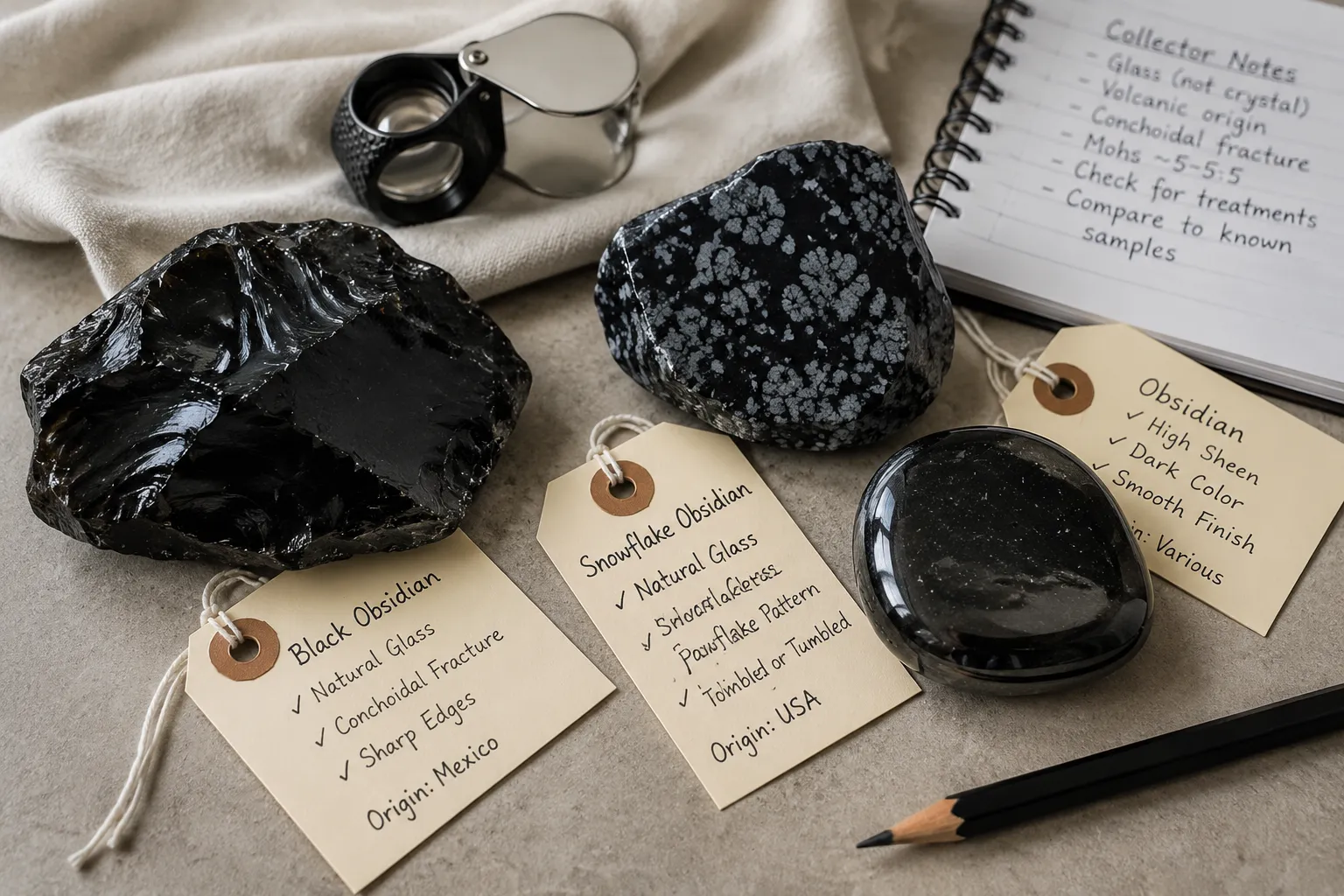
Read obsidian seller labels in layers: visible description first, material claim second, variety or trade name third, then source, object form, treatment risk, and symbolic or marketing language. Photos may support visible traits such as black glassy luster, snowflake-like inclusions, rainbow sheen, gold sheen, silver sheen, rough surfaces, or polished carving. They cannot settle exact origin, age, natural formation, artifact status, or personal effects on their own.
The buyer question is plain: which part of this label can I check with my eyes, which part needs better support, and which part is just sales language?
upward
Start with the broader guide
Use the broader guide first if you need the full scope before this page.
Split the Label Into Claim Types
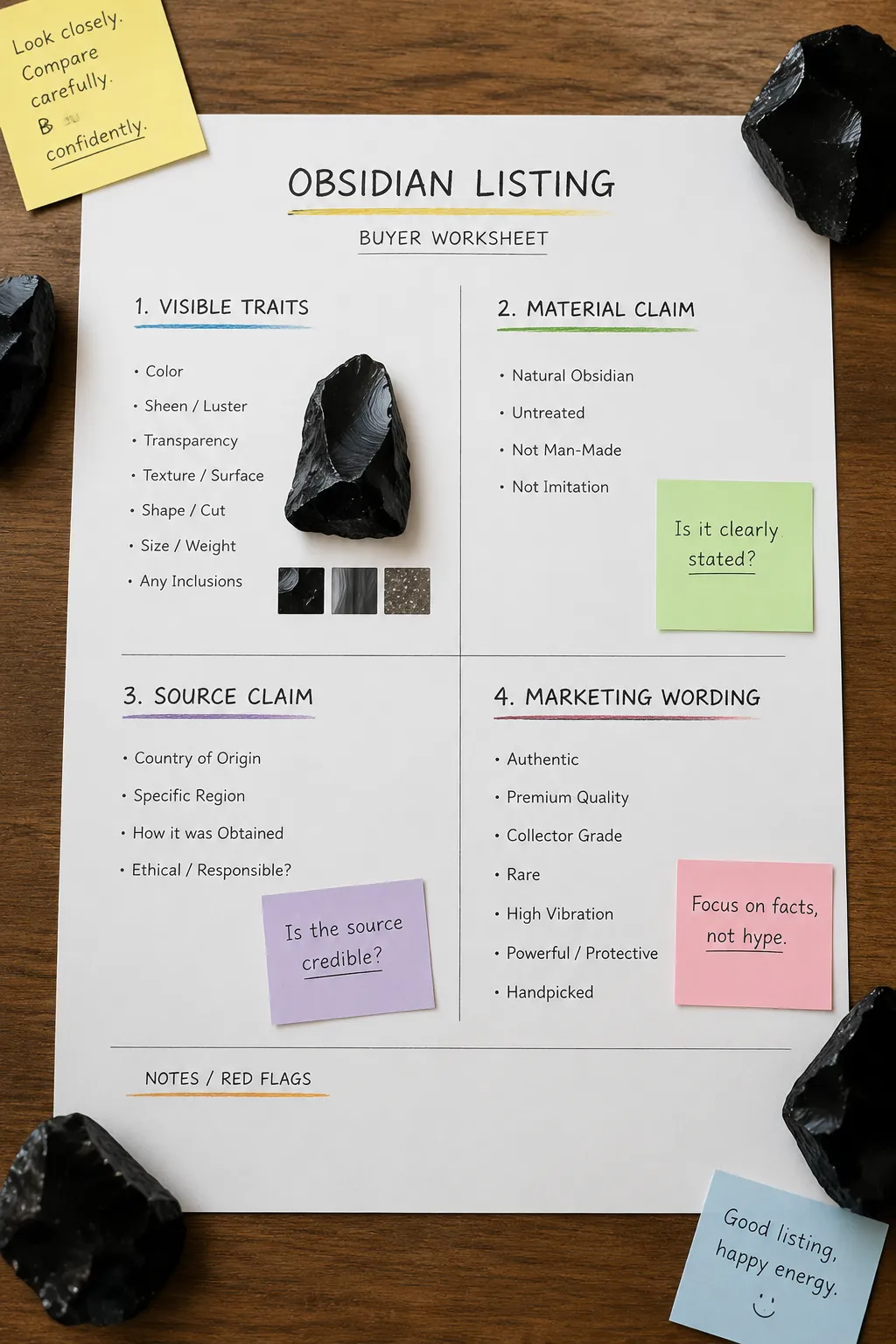
Seller titles often compress several claims into one line. A listing might say “natural rainbow obsidian tower from Mexico, powerful protection stone,” or “greenish black rough volcanic glass for knapping and lapidary.” Those words do not carry the same weight.
Obsidian is natural volcanic glass formed from rapidly cooled volcanic material. That matters because two mistakes are common. Obsidian is not a typical crystalline mineral, even when casual shop language calls it one. And not every glassy object is obsidian.
A label that says “glass” may be honest but incomplete. A label that says “obsidian” still needs visible and contextual support.
What Photos Can Support
Photos are strongest when the claim is visible. They can show a glassy surface, curved fracture edge, polished finish, dark body color, lighter patches, banding, or sheen under light. They can also show when the listing does not give enough angles to support the label.
For natural obsidian labels, do not use “only black is real” as your rule. Black is common, but collector labels also use brown, red-brown or mahogany patterns, snowflake markings, rainbow effects, gold sheen, silver sheen, and some greenish appearances. The name alone is not the point. The named feature should be visible in a believable way.
For snowflake obsidian, look for pale gray or whitish rounded inclusions scattered through a darker glassy matrix. For rainbow obsidian, ask whether the seller shows the surface from more than one angle, because the effect depends on light and polish. For gold sheen or silver sheen, the luster should appear in the photos, not only in the title.
A single front-facing photo is weak support for sheen claims. A washed-out studio image is weak support for subtle color. A finished pendant may not reveal much about the original material, especially if the listing also makes a strong natural-origin claim.
Buy the visible feature, not the adjective.
Variety Name or Trade Name?
Obsidian variety labels can be useful. “Snowflake obsidian” tells you to look for pale inclusions. “Mahogany obsidian” points toward reddish brown and black patterning. “Rainbow obsidian,” “gold sheen obsidian,” and “silver sheen obsidian” point toward optical effects that should show under suitable lighting.
These labels are not lab reports. They are inspection cues.
Trade names are different. They may be shop shorthand, regional branding, spiritual-market language, or labels attached to material that is not clearly natural obsidian. Names such as Himalayan Blue obsidian, Siberian Blue obsidian, Andara Blue obsidian, and Gaia Stone label wording should prompt more questions, especially when the material is bright, transparent, or novelty-colored.
Bright blue obsidian labels need a slower read. So do transparent obsidian colors in aqua, yellow, vivid red, or novelty blue. The cautious position is not that every colored label is impossible. It is that bright transparent novelty colors are a stronger claim than ordinary black, mahogany, snowflake, or sheen variety labels, and they deserve stronger support than a title phrase.
Ask what the label is meant to describe
- Is it a natural obsidian variety?
- Is it manufactured glass sold in an obsidian style?
- Is it a trade name with symbolic or decorative meaning?
- Is there non-sales support for the material claim?
If the answer stays vague, read the label as marketing.
Source and Provenance Claims Need More Than a Place Name
Obsidian source claims can sound precise: Mexico, Oregon, Armenia, Iceland, or another named region. Some locality labels may be accurate, especially from careful sellers who document their rough material. The wording itself still does not confirm origin.
Provenance is a stronger claim than appearance. A dark glassy stone may look consistent with obsidian, but exact source attribution can require technical characterization beyond ordinary buyer inspection. That does not make every seller wrong. It means you should separate a plausible locality note from a proven source claim.
The same caution applies to “ancient,” “artifact,” “ceremonial,” “arrowhead,” and “point” labels. A modern knapped point and an archaeological object are different claims. Photos can show shape, flake scars, edge work, and material appearance, but they cannot settle age, legal status, or cultural origin for a buyer browsing a shop page.
If a label implies artifact status, treat it as a separate question. It is no longer just an obsidian variety label.
Artificial Glass, Color, and Shortcuts
The phrase “volcanic glass” can be useful because obsidian is volcanic glass. It can also blur the issue when a listing uses glassy language without explaining natural formation.
Obsidian is glass. Not all glass is obsidian.
Artificial glass imitation labels are most concerning when a title combines dramatic color with natural-origin wording. Bright transparent blue, aqua, yellow, or vivid red “obsidian” should not be accepted only because the listing says “natural.” A bubble, cool feel, or simple home test is not a reliable shortcut to certainty. Avoid scratch testing as a buyer check; it can damage the item or another surface, and it still may not answer the real question.
Use non-destructive checks instead
- Look for multiple photos in neutral light.
- Compare the title against the visible surface.
- Ask whether “blue,” “green,” or another color means body color, reflected sheen, coating, or trade naming.
- Check whether the seller separates “natural obsidian” from “glass imitation.”
- Be more cautious when unusual color is paired with strong rarity language.
Some natural obsidian may show translucency in thin edges when held to light. That is not the same as a bright transparent glass object in a novelty color. The distinction matters.
Object Form Is Not Identity Proof
Labels such as rough, tumbled, bead, cabochon, tower, palm stone, blade, point, or carving describe form. They do not prove material by themselves.
A rough piece may show fracture surfaces and glassy luster. A polished bead may hide useful texture. A carving may be attractive but hard to inspect. A point or blade-shaped object may introduce sharp edges and separate authenticity questions. Broken, raw, or worked obsidian can have sharp conchoidal edges, so handling language should stay practical.
If you are buying jewelry, ask whether the listing describes the stone, the setting, or both. “Black obsidian bracelet” may mean natural obsidian beads, glass beads sold under that name, dyed or coated material, or a black glass-like style. The photos and seller details should narrow that down.
For carvings and polished pieces, a strong label is usually simple: material claim, variety or visible feature, size, finish, and any uncertainty. A label that grows more elaborate as the evidence gets thinner deserves a slower read.
Symbolic Language Belongs in a Different Box
Many obsidian shop labels include symbolic meaning. They may mention protection, emotional themes, energy language, or traditional associations. On a collector page, those words belong in the category of belief, cultural framing, personal interpretation, or seller language. They are not material identification, and they do not verify natural origin.
This matters because symbolic wording can make a listing feel more confident than it is. A phrase about meaning may sit beside a variety name, a source claim, and a rarity claim in the same title. Do not let the symbolic part carry the factual part.
A cleaner reading
- “Black” is a visible color claim.
- “Obsidian” is a material claim.
- “Mexico” is a source claim.
- “Protection stone” is symbolic or marketing language.
- “Ancient artifact” is a separate authenticity claim.
Once those are separated, the label becomes easier to judge.
Quick Label-Reading Checklist
Before buying labeled obsidian, pause on these questions:
- What part of the label describes something I can see?
- Do the photos show that feature clearly, from enough angles?
- Is the variety name descriptive, or is it a trade name?
- Does the seller explain unusual color, transparency, coating, or glass imitation risk?
- Is a source or provenance claim supported by anything beyond the title?
- Does the object-form wording imply age, artifact status, or cultural origin?
- Is symbolic language being mixed with factual identification?
- Would I still understand the listing if I removed the marketing adjectives?
If the visible traits, material claim, and seller explanation line up, the label is more useful. If the listing leans on dramatic color, vague rarity, exact origin, and personal-effect language without support, treat it as uncertain.
The Practical Rule
Read the glassy luster before the label. Then read the label as a stack of claims.
A seller can reasonably describe color, polish, inclusions, sheen, size, form, and intended use. A careful seller may also provide a locality note or material background. But obsidian shop labels cannot confirm everything they imply. Natural origin, exact source, treatment status, artifact authenticity, and symbolic meaning all need different kinds of support.
For an ordinary collector purchase, the better decision is usually not “real or fake” in one jump. It is narrower: the visible traits match the name, the unusual claims are modest or supported, and the parts you cannot verify are not the reason you are buying.