Material comparison
Obsidian vs Jet: How These Black Materials Differ
Obsidian and jet can both show up as polished black beads, cabochons, pendants, or carvings, but they are not the same material. In the simplest obsidian vs jet comparison, obsidian is natural volcanic glass, while jet is an organic gem material associated with fossilized wood and lignite-like carbon-rich material.
That origin difference affects the way each piece feels, wears, chips, scratches, and should be cared for. Jet often feels unusually light for its size and may feel warmer in the hand. Obsidian usually feels denser, cooler, and more glass-like. Those clues are useful, but they are not proof on their own.
upward
Start with the broader guide
Use the broader guide first if you need the full scope before this page.
Quick answer
Obsidian behaves more like glass: cool, dense, reflective, and vulnerable to chipping. Jet behaves more like a soft organic gem material: unusually light for its size, often warmer-feeling, and more vulnerable to scratching and abrasion.
The core difference: volcanic glass versus organic jet
The most important difference between jet and obsidian is how they form.
Obsidian forms when silica-rich lava cools so quickly that crystals do not grow in the usual way. The result is a natural glass, not a crystalline mineral in the strict sense. Collector descriptions often call it “volcanic glass,” which is more accurate than simply calling it a black mineral. Obsidian may be black, smoky, brownish, gray, or show sheen, banding, inclusions, or other visible effects depending on the piece.
Jet belongs to another material family. Gemological and geological references describe jet as an organic gem material or mineraloid linked to fossilized wood, coal, or lignite-like material. In casual collector language, “jet fossilized wood” is a common shorthand, though classification wording can vary by source and locality. The practical point is that jet is carbon-rich and organic in origin, not volcanic glass.
For a quick black gemstone comparison, this is the useful split: obsidian behaves more like glass; jet behaves more like a lightweight organic gem material.
What you can observe without damaging the piece
A finished piece should not be scratched, heated, broken, harshly rubbed, or exposed to chemicals just to answer a casual identification question. Many old “tests” can damage polished jewelry or carvings, and some only add another clue rather than giving a reliable answer.
Use non-destructive clues instead.
Weight and hand feel
Jet is widely known in jewelry and collecting contexts as a lightweight black material. More precisely, it is lightweight compared with many stone or glass pieces of similar size. If two beads are about the same size and one feels unexpectedly light, jet becomes a possibility.
Obsidian usually feels heavier than jet of the same apparent size. It can also feel cool and glassy when first handled, much like other polished glass materials. That does not mean every cool black object is obsidian; black glass, onyx, chalcedony, black spinel, and other materials can also feel cool and dense.
Use weight and temperature as clues, not verdicts.
Surface and luster
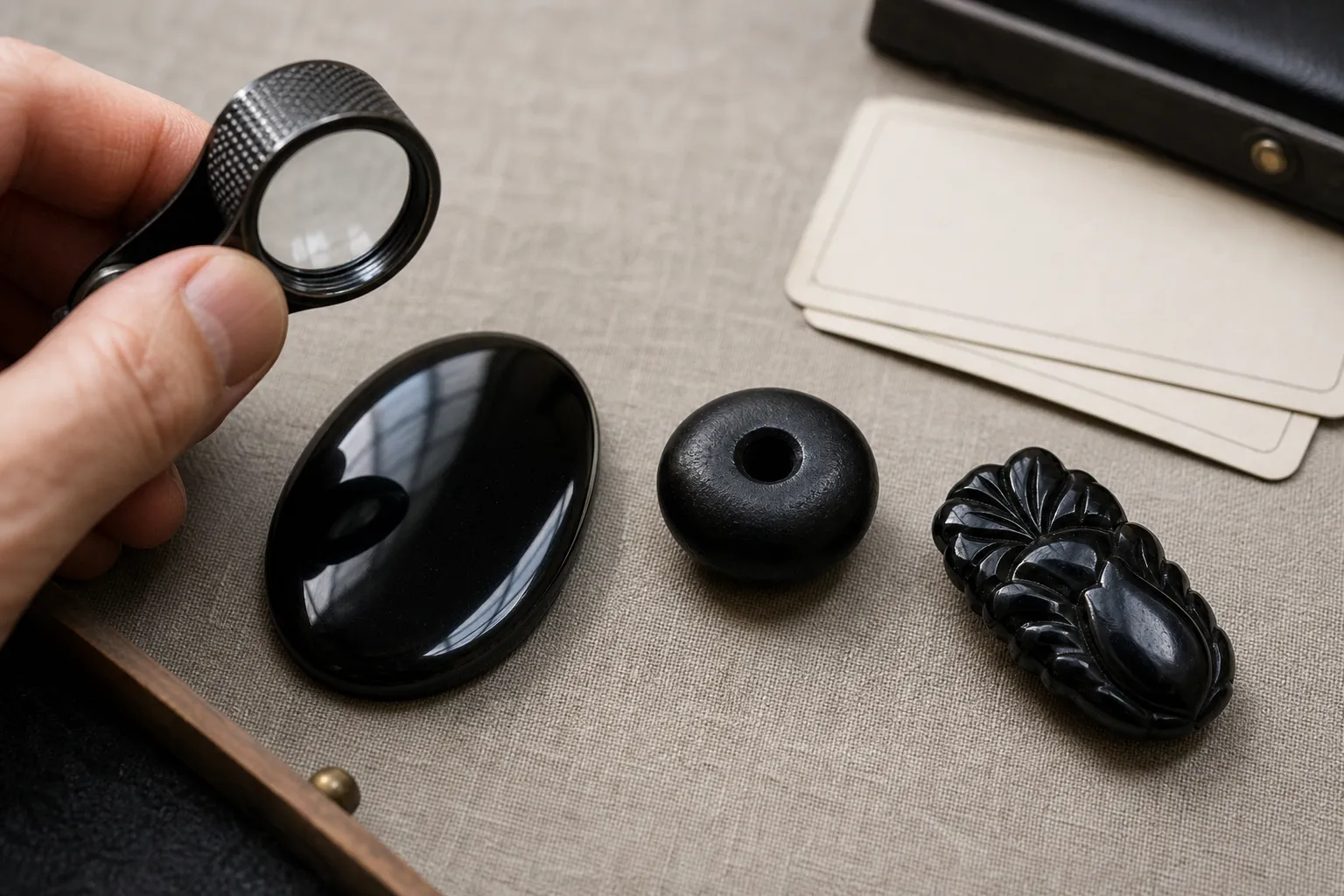
Polished obsidian usually has a clear glass-like luster. Black obsidian can look deep, reflective, and smooth, especially on a well-polished cabochon or bead. If chips or fractures are already present, they may show a glassy break pattern. Broken obsidian can form sharp edges, which is one reason it has a long history as a cutting material.
Jet can also polish to a strong black shine, but its luster is often described as resinous, waxy, or sometimes glassy depending on the specimen and finish. Some jet looks black; some may read as brownish black under strong light or along thin edges. A softer, warmer-looking polish can support a jet identification, especially when the piece is also very light, but polish alone is not enough. Black glass and plastic imitations can also be shiny.
Hardness and wear clues
In an obsidian vs jet hardness comparison, obsidian is generally harder than jet, but the practical meaning matters more than the number.
Jet is soft enough that it can scratch, dull, or abrade more easily than many familiar black gems. It is best treated as a lower-impact material, especially in older pieces, carved beads, pendants, earrings, or brooches. Rings and bracelets are harder on jet because they hit desks, door frames, clasps, and other jewelry.
Obsidian is less soft than jet, but it is still glass. Its main concern is chipping, fracturing, or breaking with sharp glass-like edges. It can be durable enough for many polished collectibles and jewelry pieces, but it does not like impact.
Obsidian and jet identification: useful clues, not proof
A practical obsidian and jet identification process should stay probabilistic. You are building a case from several clues, not proving identity from one feature.
- Very light for its size: may suggest jet, plastic, or another lightweight material.
- Cool, dense, glassy feel: may suggest obsidian, black glass, onyx/chalcedony, or another polished black material.
- Resinous or waxy black polish: may support jet, especially with light weight.
- Strong glass-like luster and volcanic context: may support obsidian.
- Old mourning-style jewelry or antique black carvings: may raise the possibility of jet, especially Whitby jet, but does not prove it.
- Modern “jet black” wording: usually describes color, not material.
The best next step depends on the piece. For a low-cost loose bead, careful observation may be enough for sorting. For antique, sentimental, inherited, or expensive jewelry, professional gemological identification is more appropriate than home testing.
This is especially true because jet, black glass, plastic, onyx, chalcedony, shungite, black tourmaline, black spinel, lava rock, and other dark materials can appear in the same buying environment.
There is also a naming issue inside the phrase “jet stone vs obsidian.” Jet is often sold as a stone, but it is not a crystalline stone in the same sense as quartz or tourmaline. Obsidian is also casually called a stone, but scientifically it is volcanic glass. Shop language is convenient; material language is more precise.
Jewelry and care differences
The care difference follows the material difference.
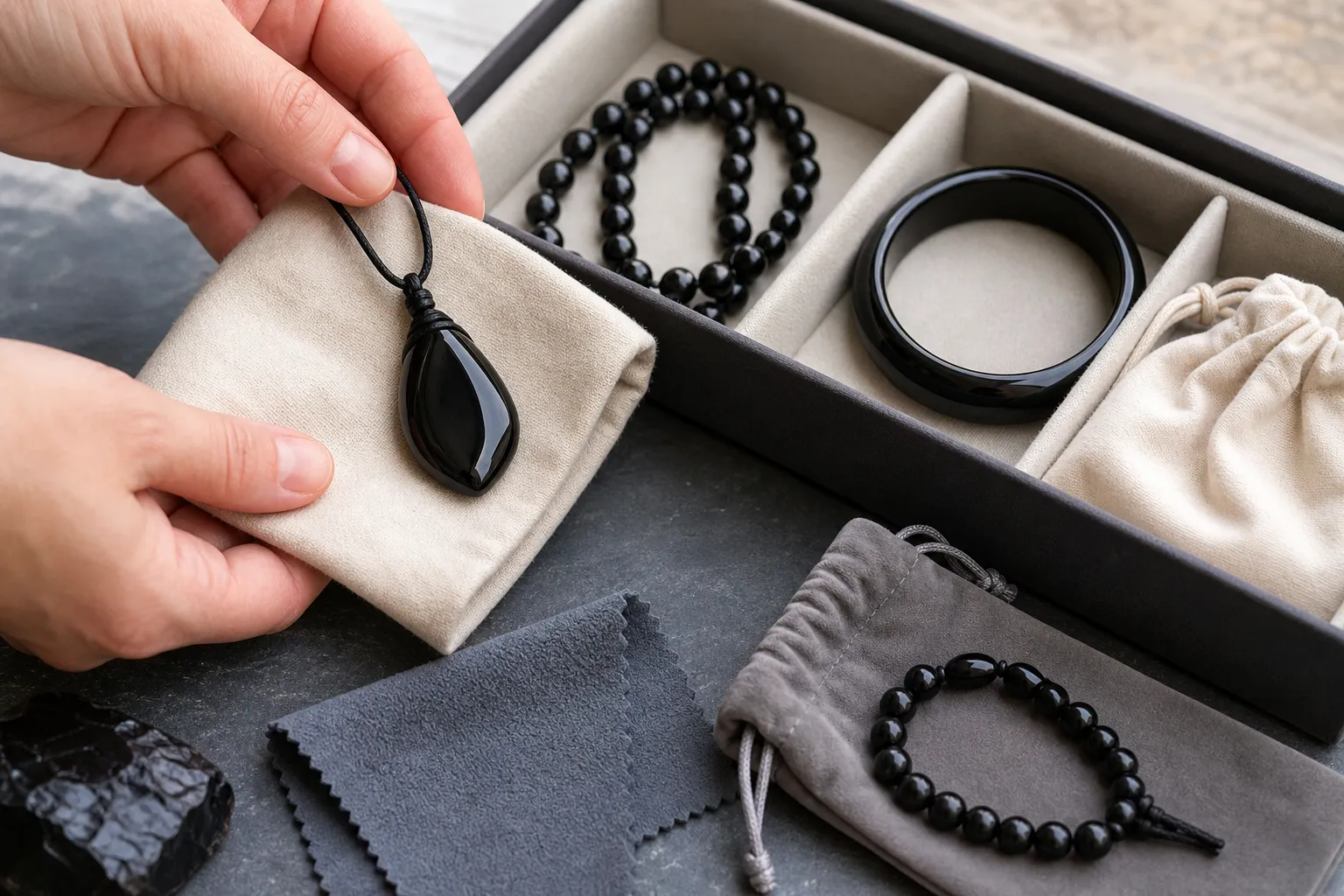
Jet should be handled gently because it is relatively soft and can be vulnerable to scratching, abrasion, and rough handling. Conservative care for jet jewelry usually means protected storage, light cleaning, and avoiding harsh cleaning methods. A soft cloth is usually the first choice. If light cleaning is needed, use mild soap, warm water, and gentle contact rather than aggressive brushing or soaking. Keep jet away from rough storage with harder stones and metal edges.
Obsidian care is different because the material is glassy. A polished obsidian piece can usually be wiped with a soft cloth and handled like a glass-like collectible. The main caution is impact: obsidian can chip, fracture, or create sharp edges if broken. Do not toss obsidian beads, points, or carvings into a crowded tray with harder stones, metal tools, or heavy pieces.
For both materials, avoid ultrasonic cleaning, steam cleaning, strong chemicals, and experimental home tests on finished jewelry unless a qualified jeweler has assessed the piece. This matters even more for older settings, glued components, delicate carvings, and pieces where the seller label may not match the actual material.
A simple storage rule works well: keep jet separate because it scratches more easily; keep obsidian protected because it chips like glass.
Common naming confusion: French jet, Whitby jet, and “jet black”
Some of the confusion around jet and obsidian comes from trade names rather than from the materials themselves.
French jet
French jet is one of the most important terms to know. Despite the name, French jet refers to black glass, not true jet. If a necklace is described as French jet, do not assume it is fossilized wood or organic jet material. It belongs on the glass side of the comparison, not the genuine jet side.
Whitby jet
Whitby jet is a locality and heritage term associated with jet from the Whitby area in Yorkshire, England. It has strong historical jewelry associations, especially with nineteenth-century mourning jewelry. That history explains why shoppers often compare Whitby jet vs obsidian when looking at old black jewelry. Still, a locality or style label is not the same as material identification.
Jet black
Jet black is usually just a color phrase. A seller may call something “jet black” simply because it is deep black. The phrase does not mean the item is made of jet.
Other names can also blur the picture: Acoma Jet, Oltu or Erzurum stone, Spanish Jet, black glass, blackstone, plastic imitation, Hemalyke, shungite, black onyx, chalcedony, black spinel, black tourmaline, lava rock, and magnesite may appear near jet or obsidian in shopping contexts. Some are separate materials; some are trade or imitation terms. The point is not to memorize every black material, but to avoid assuming that every glossy black piece must be either obsidian or jet.
So, is jet the same as obsidian?
No. Jet is not the same as obsidian. Jet is an organic gem material associated with fossilized wood and lignite-like formation; obsidian is volcanic glass.
They can overlap visually because both may be polished black, but they differ in origin, weight, feel, hardness, wear behavior, and care. If your piece is light, warm-feeling, softly lustrous, and easily worn, it may behave more like jet. If it is denser, cooler, strongly glassy, and prone to glass-like chipping, it may behave more like obsidian.
If the item is valuable, antique, or important to you, treat these observations as clues and get a professional identification rather than relying on damaging home tests.
FAQ
Which is lighter, jet or obsidian?
Jet is usually lighter than obsidian when the pieces are similar in size. This is one of the most useful handling clues, but it is not enough for a confident identification because plastics and other materials can also be light.
Is obsidian harder than jet?
Generally, yes. Obsidian is harder than jet, but it can still chip or break because it is glassy. Jet is softer and more vulnerable to surface wear, scratching, and abrasion.
Is French jet the same as real jet?
No. French jet is black glass, not true jet. The name is a common source of confusion in antique and vintage jewelry descriptions.
Can I identify obsidian or jet from a photo?
A photo can show color, luster, shape, and sometimes visible wear, but it usually cannot confirm the material by itself. Weight, hand feel, construction, age, and professional testing may be needed, especially for valuable or antique pieces.