
Hand-sample identification
Obsidian vs Black Tourmaline: What Looks Different in Hand Samples
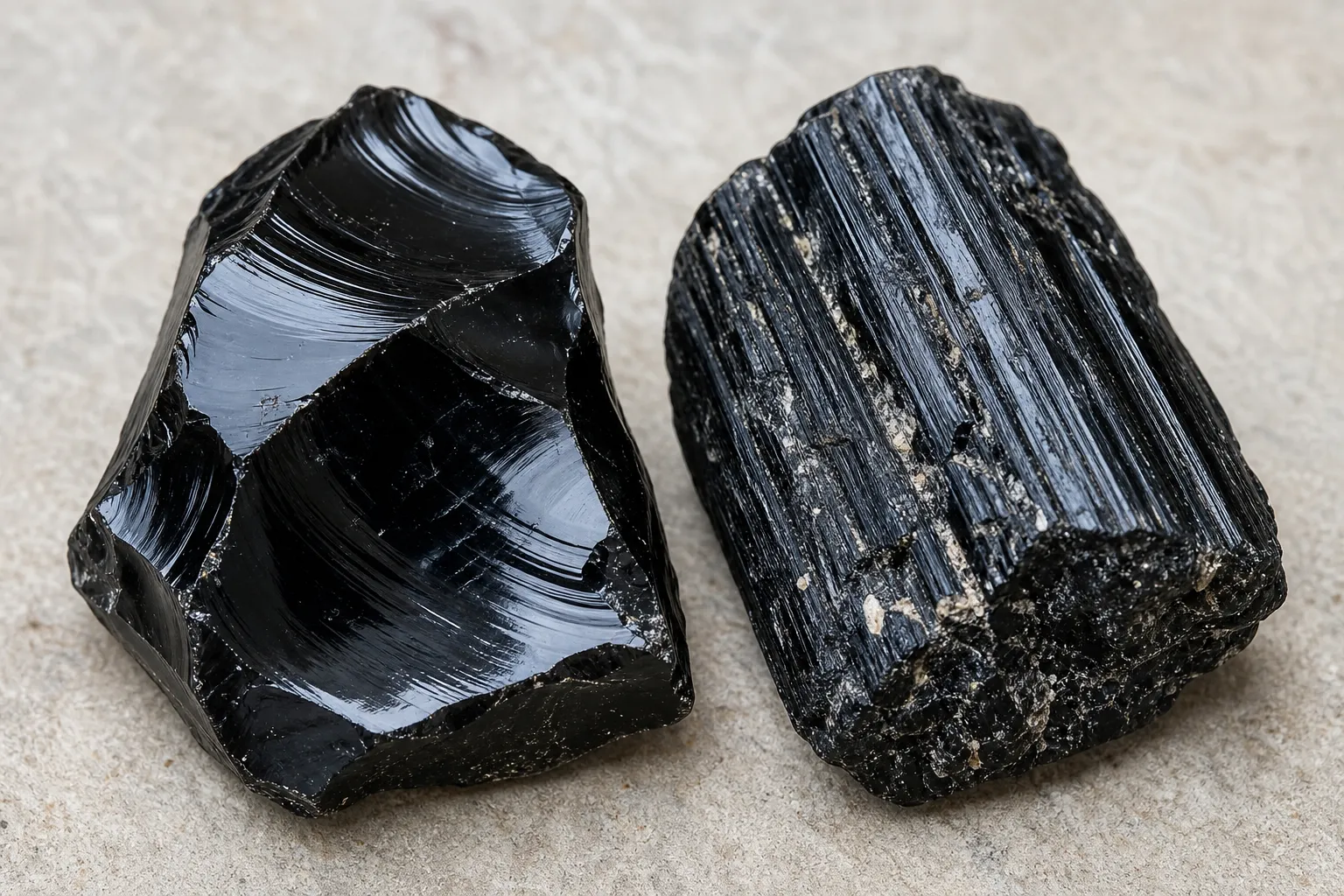
If you are comparing obsidian vs black tourmaline in the hand, begin with texture and structure rather than color. Obsidian is volcanic glass, so rough or broken pieces often look smoother, glassier, and more visually uniform, with curved, shell-like break surfaces when chipped. Black tourmaline is usually schorl, a crystalline tourmaline mineral, so rough pieces may show columns, ridges, grooves, prismatic shapes, or lumpy crystalline surfaces.
The difference is usually clearest in rough chunks. Polished beads, pendants, and bracelets can make both materials look simply glossy and black. A single photo, seller label, or one shiny surface is not enough for certain identification when the answer matters.
Quick comparison
upward
Start with the broader guide
Use the broader guide first if you need the full scope before this page.
The quickest hand-sample comparison
Look at the whole piece before focusing on one reflection. The main obsidian and tourmaline differences come from what the material is: obsidian is natural volcanic glass; black tourmaline is a crystalline mineral.
What you can see
Obsidian
Black tourmaline / schorl
Overall surface
Often smooth, glassy, reflective, and fairly uniform
Often uneven, crystalline, ridged, grooved, or lumpy in rough form
Broken areas
May show curved, shell-like conchoidal fracture
More likely to show uneven mineral breaks, splintery areas, or broken crystal masses
Rough shape
Shards, flakes, chunks, nodules, or glassy masses
Prismatic pieces, columns, striated rods, radiating groups, or rough crystalline chunks
Edges
Fresh breaks can be sharp and glass-like
Edges can also be sharp, but the surface may keep ridges or striations
Polished beads
Can become very glossy and uniform
Can also become glossy, making separation harder
Best visible clue
Glassy surface plus conchoidal fracture
Ridged texture plus crystal habit
This is a visual sorting method, not a lab result. It helps you decide whether a hand sample looks more consistent with obsidian or with black tourmaline.
Why the material type matters
The important difference is not shop category, bracelet style, or symbolic language. It is structure.
Obsidian forms when silica-rich lava cools quickly enough to become volcanic glass. In everyday collecting, people may call it an “obsidian crystal,” but physically it is better described as glassy volcanic material rather than a true mineral crystal. That glassy nature is why many obsidian pieces look smooth, reflective, and almost frozen-liquid-like when broken or polished.
Black tourmaline is different. The black variety most collectors mean is schorl, a member of the tourmaline group. Tourmaline is crystalline, and rough black tourmaline often preserves signs of growth: long columns, lengthwise grooves, striated sides, prismatic outlines, or clustered uneven surfaces.
That is why rough samples usually tell you more than finished jewelry. A raw obsidian shard may still show glassy fracture. A raw black tourmaline piece may still show ridged crystal habit. Once either material is cut, tumbled, drilled, or polished, some of the best clues may be reduced or removed.
Surface clues: glassy uniformity vs ridged crystal texture
Turn the piece under steady light. Do not judge from one bright flash, because many black stones can shine.
An obsidian glassy surface often looks continuous. Even when it has flow lines, small inclusions, or color effects, the surface impression is usually smoother and more glass-like than crystalline. A black obsidian chunk may resemble dark bottle glass, a glossy pebble, or a uniform black mass. Snowflake obsidian, golden sheen obsidian, silver obsidian, and rainbow obsidian can complicate the color, but they still belong to the same volcanic glass family. Their patterns or sheen do not make them black tourmaline.
Rough black tourmaline usually interrupts the light differently. Instead of one continuous glassy face, you may see lengthwise ridges, grooves, stacked-looking surfaces, uneven crystalline breaks, or a prism-like outline. Some pieces look like black rods or bundled columns; others are chunkier, but still show mineral texture rather than a melted-glass look.
A useful question is: does the surface look like it broke from a glassy mass, or like it grew as a mineral? That question is not perfect, but it points your eye toward the right clues.
Fracture and edges: what conchoidal fracture looks like
Conchoidal fracture is one of the strongest visible obsidian clues when a broken surface is present. In plain terms, it means a curved, shell-like break, similar to the rounded ripple shapes seen in broken glass or chipped flint.
On a rough obsidian hand sample, look for:
- Curved, scoop-like break faces
- Smooth fracture surfaces that catch light like glass
- Sharp, thin edges on fresh chips
- Dark glassy interiors, sometimes with slightly translucent thin edges
Not every obsidian specimen shows a perfect textbook fracture. Weathering, tumbling, abrasion, polish, or outer cortex can soften the clue. Some pieces are rounded, frosted, or naturally worn, and those surfaces may hide the fresh glassy break.
Black tourmaline can also break sharply, but rough pieces are more often recognized by crystal habit, striations, grooves, and uneven mineral texture. A fractured black tourmaline chunk may look jagged or splintery while still showing lengthwise ridging or column fragments. Parallel grooves running along a black prism-like form point more toward black tourmaline than obsidian.
Handle freshly broken obsidian with care. It can behave like glass and may have very sharp edges.
Rough samples are easier than polished beads
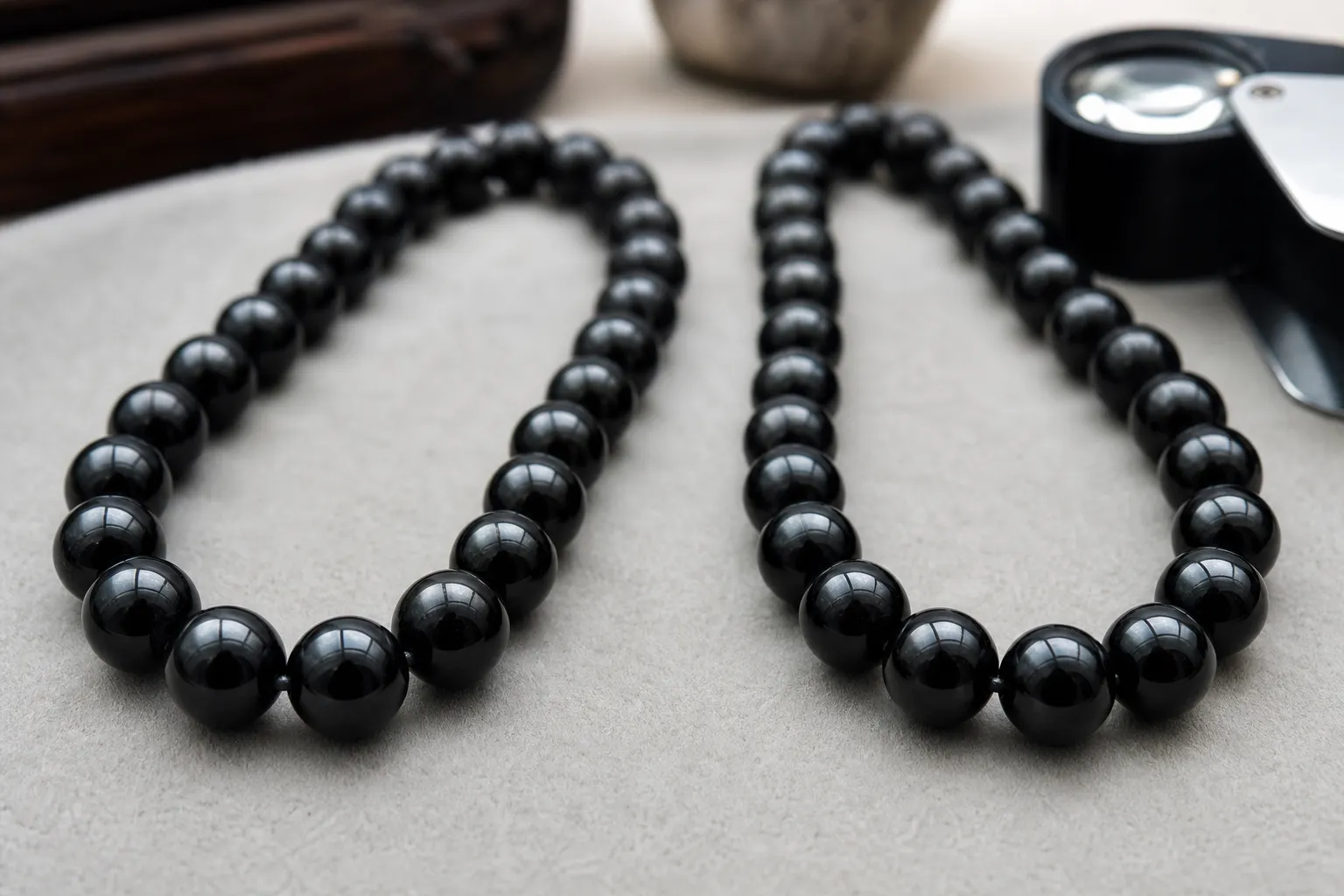
Many black tourmaline vs obsidian questions come from bracelets, pendants, and bead strands. That is where appearance becomes less reliable.
A polished obsidian bead can be black, glossy, and smooth. A polished black tourmaline bead can also be black, glossy, and smooth. Drilling, tumbling, cabochon cutting, and high polish remove or soften the features that help most: obsidian’s broken glassy fracture and black tourmaline’s ridged crystal habit.
In a black obsidian bracelet vs black tourmaline bracelet comparison, the bead shape may tell you more about the lapidary finish than the original material.
Polished obsidian may still look especially uniform and glass-like. Silver obsidian, golden sheen obsidian, and rainbow obsidian may show sheen under certain lighting, but sheen alone is not a universal test. Polished black tourmaline may show subtle surface irregularities, tiny pits, or internal-looking texture, but those signs are not consistent enough to confirm identity by themselves.
More accurate wording would be:
“This looks more like obsidian because the surface is very uniform and glassy.”
“This looks more like black tourmaline because the rough area shows ridges or columnar texture.”
“This bead cannot be identified confidently from appearance alone.”
“The label may be right, but the visible clues are limited.”
That is better than pretending every black polished bead can be sorted instantly.
Common points of confusion
One common mistake is treating “schorl” as a name for black obsidian. It is not. Schorl is black tourmaline. Obsidian is volcanic glass.
Another confusion comes from the word “crystal.” In shops and casual collecting, people may say “obsidian crystal” because obsidian is sold alongside crystals and stones. That wording is common, but it can blur the physical difference. For identification, the glass-versus-crystal distinction matters more than the display category.
Color also does not decide the answer by itself. Black obsidian and black tourmaline can both be very dark. Some obsidian varieties show snowflake patterns, gold sheen, silver sheen, or rainbow effects. Rough black tourmaline may look brownish-black, gray-black, or slightly shiny depending on the specimen. Color becomes useful only when combined with texture, fracture, and habit.
Other black materials can add confusion in jewelry listings: onyx, dyed chalcedony, hematite, black spinel, shungite, and more. They are not the focus here, but if your sample shows neither obsidian’s glassy fracture nor black tourmaline’s ridged crystal habit, it may be better to widen the comparison instead of forcing the piece into one of these two names.
Meanings and “which is better” are separate questions
Some buyers compare obsidian and black tourmaline through symbolic or personal-use language. Sellers and collectors may associate both black stones with protection, grounding, or similar themes, but those associations do not identify the material and should not be treated as physical results.
For identification, a claimed meaning does not help. A bracelet sold with a particular intention may still need ordinary material checking. A pendant described in spiritual language may be obsidian, black tourmaline, onyx, or another black stone.
If your question is “which is better for my collection,” the practical answer depends on what you want to study. Choose obsidian if you want volcanic glass, sheen varieties, glassy fracture, or obsidian-specific forms. Choose black tourmaline if you want a crystalline mineral, schorl terminology, ridged habit, or prismatic rough specimens. Neither is universally better for every collector.
When visual inspection is not enough
A hand-sample comparison works best when the piece is rough, well lit, and large enough to show texture. It is weakest when the sample is a tiny bead, a dark photo, a heavily polished pendant, or a seller image with no visible surface detail.
Do not rely only on:
- A single glossy reflection
- A product title
- Casual weight impression
- One online photo
- A generic “black crystal” label
- A seller description without useful inspection details
If identification matters for purchase, resale, cataloging, or a serious collection record, ask for in-person help from a qualified gemologist, jeweler, mineral dealer, museum contact, or testing lab. That is especially sensible when a sample is polished, expensive, unusually described, or visually ambiguous.
A practical inspection path
Use this order when holding the sample:
- Look for glassy uniformity. A smooth, continuous, reflective surface points toward obsidian, especially if the piece looks like volcanic glass rather than a grown crystal.
- Search for conchoidal fracture. Curved, shell-like breaks strongly support obsidian when present.
- Check for ridges and grooves. Lengthwise striations, columnar pieces, and prismatic habit point toward black tourmaline.
- Separate rough from polished clues. Rough texture is more informative; polish can hide the original surface.
- Use cautious conclusions. Say “likely,” “consistent with,” or “not enough visible detail” when the piece does not show clear features.
In simple terms: obsidian usually gives itself away by looking like volcanic glass; black tourmaline usually gives itself away by looking like a ridged crystalline mineral. The more heavily the surface has been polished, the less confident a visual answer should be.