Collector evidence
What an Old Handwritten Obsidian Label Can and Cannot Prove
A glassy black edge, a snowflake pattern, or a faint sheen should be read beside the paper label, not beneath it. An old obsidian specimen label can suggest a mineral name, a written locality claim, a former collector, an older catalogue system, or a path through a collection. It cannot, by itself, prove the geological source, the age of the specimen, the age of the writing, the value of the piece, or that the label has always belonged with that exact stone.
Treat the label as a serious clue. Then ask what still connects the paper, the piece, and the claim.
upward
Read the full overview first
Use the broader guide first if you need the full scope before this page.
First answer
The label can support a trail of names, places, numbers, and collection history. It cannot replace visible inspection, matching records, or careful verification of the exact claim being made.
What the Label Can Reasonably Support
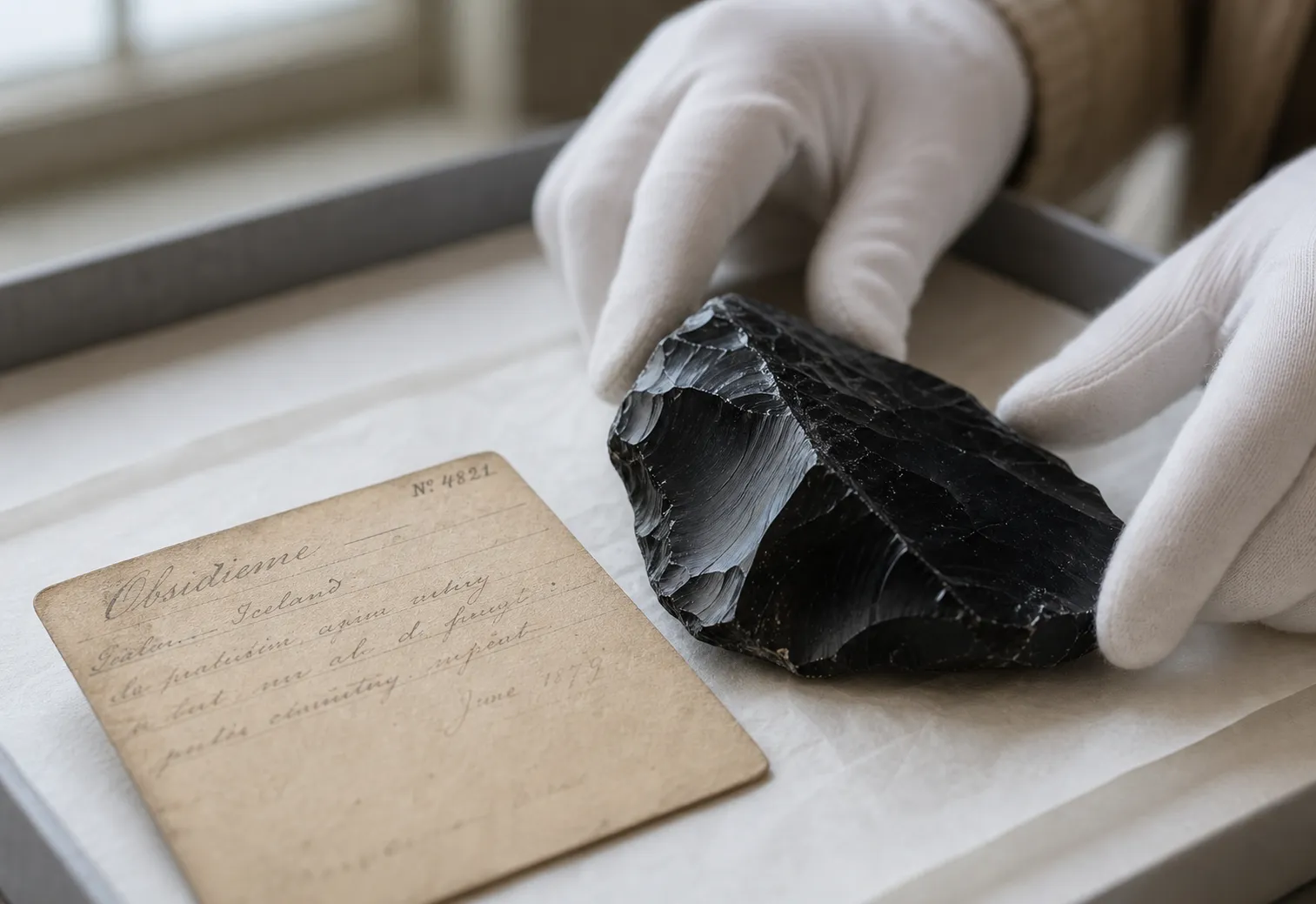
A handwritten mineral label is strongest when it records information that can be read, compared, and connected to something outside the card itself. For an obsidian collector, that may mean a working name such as “obsidian,” a variety name such as snowflake obsidian, a locality, a collector name, a dealer name, a date, a catalogue number, or an older spelling of a place.
That matters because mineral specimens carry more than visible traits. They also carry associated information: labels, numbers, boxes, ledgers, invoices, old collection cards, and later catalogue notes. In plain collector terms, the old collection label can help explain why the specimen has been called what it has been called.
A useful label may suggest
- The name previously assigned to the specimen.
- A locality written by a collector, dealer, institution, or previous owner.
- A collection history link, such as a personal collection name or accession-style number.
- A time window, if the paper, wording, or record system can be compared with related material.
- A clue for catalogue number verification.
The key word is suggest. A label is a record, not the rock. If the stone has glassy luster, conchoidal fracture, and visible traits consistent with obsidian, the written name becomes more plausible. If the card says “obsidian” but the specimen does not look like volcanic glass, the paper should slow you down rather than settle the question.
Old labels also have their own value as historical records. Mineral label archives and manuscript-label collections show how labels can preserve handwriting, older locality names, dealer networks, institutional habits, and past cataloguing styles. That historical value can be real even when the label does not prove every claim written on it.
What It Cannot Prove on Its Own
An old handwritten label cannot independently prove obsidian provenance. That word needs care. Collectors often use provenance to mean ownership or collection history; obsidian research may use it to mean geological source determination. Those questions can overlap, but they are not the same.
A written locality claim is not the same as a verified geological source. For obsidian, exact source attribution may require systematic characterization and comparison of material properties or composition. A card that says “Mexico,” “Oregon,” “Lipari,” or another locality may be a useful lead, but it is not the same as compositional provenance work.
The label also cannot prove that the specimen itself is old. Obsidian may be geologically ancient, but a collector label date is not the formation date of the volcanic glass. A date may refer to collection, purchase, cataloguing, relabeling, or a previous owner’s note. It may also have been copied from another label.
Nor can the label prove that it has always belonged with the stone. Labels can be separated from boxes, moved between drawers, copied onto newer cards, or paired with the wrong specimen during estate sorting. A beautiful antique specimen label beside a stone is not enough if there is no physical, numerical, or documentary link between them.
Be especially cautious when a label is used to imply market certainty. Phrases such as “old label,” “vintage label,” “previous collection,” and “antique specimen” can make a listing sound more settled than the evidence allows. The paper may increase collector interest, but interest is not corroboration.
How to Read the Paper and the Stone Together
Start with the label exactly as it is. Do not improve it in your notes before you understand it. Transcribe the words, line breaks, numbers, punctuation, and uncertain letters. If a word is unclear, mark it as uncertain rather than choosing the most convenient reading.
Handwritten labels can be rich and stubborn. Old handwriting, abbreviations, faded ink, and unfamiliar place names can make transcription uncertain. That is not a reason to ignore the label. It is a reason to record the uncertainty.
Then inspect the specimen. Obsidian is volcanic glass, often with a glassy appearance and conchoidal fracture. It is commonly black, though pieces may show snowflake-like crystal patterns, sheen, banding, or other visible features. Broken edges can be sharp, so handle chipped or loose material carefully.
The visual check should answer a modest question: does the specimen look compatible with the label? A label saying “snowflake obsidian” should lead you to look for pale, rounded or clustered crystal patterns in a dark glassy ground. A locality label should lead you to ask whether that place is known in the collecting record for obsidian or for the variety name being used. A catalogue number should lead you to look for a matching number on a box, tray, ledger, database entry, invoice, or older card.
Practical label corroboration checklist
| Checkpoint | What It Can Support | What It Still Cannot Settle |
|---|---|---|
| Readable mineral or variety name | Prior identification or specimen designation basis | Exact source or full authenticity |
| Written locality | A locality claim worth checking | Verified geological source |
| Collector or dealer name | Possible collection history | Complete chain of custody |
| Catalogue number | Link to a ledger, box, or database if matched | Meaning without the matching record |
| Old handwriting or paper | Historical context and possible age clue | Age of the specimen or truth of the claim |
| Matching visible traits | Plausibility of the label | Final identification from appearance alone |
The strongest case is cumulative. Paper, stone, number, record, and visible traits all point in the same direction. The weakest case asks the label to do all the work.
When the Label Becomes More Persuasive
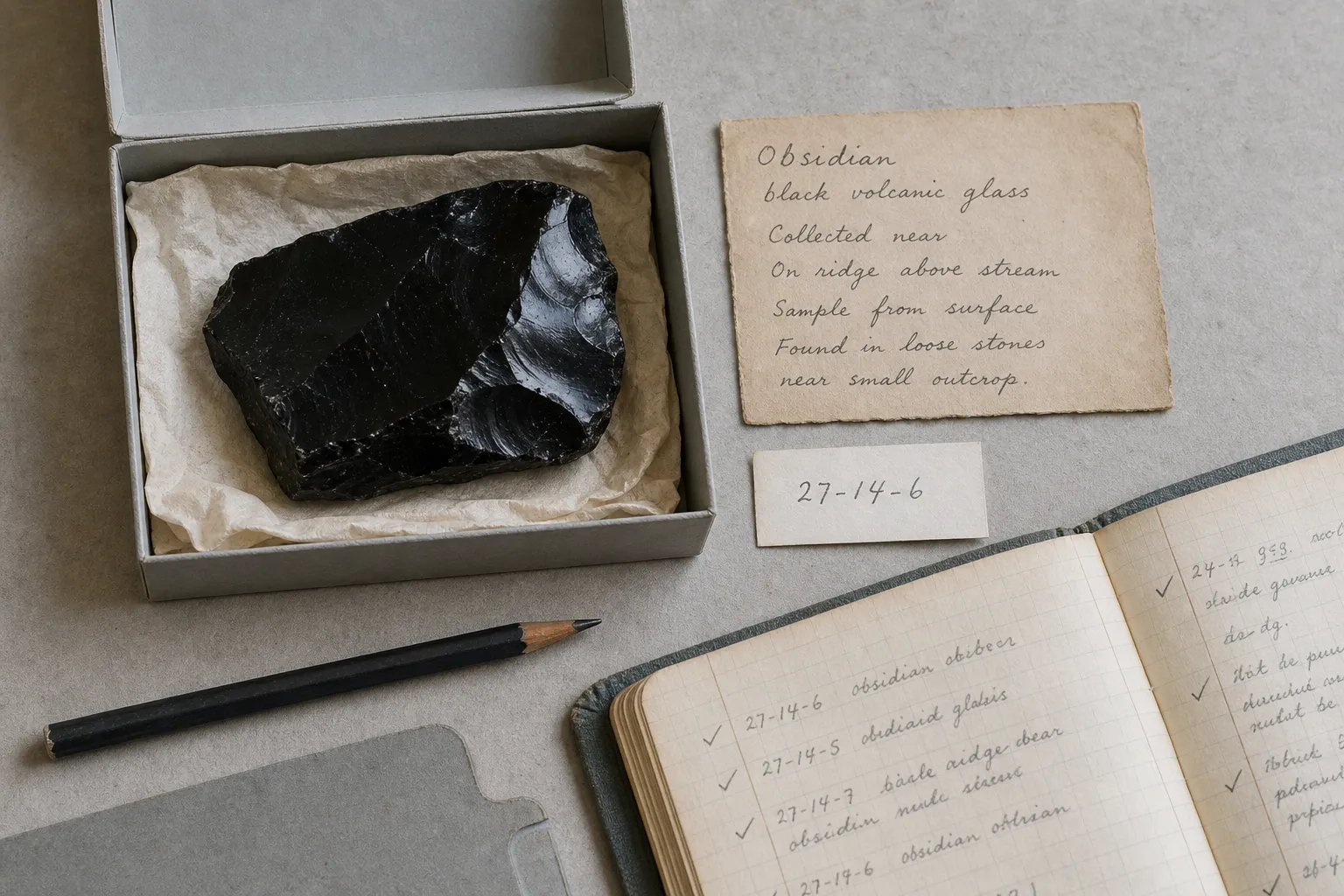
An old obsidian locality label becomes more useful when it remains physically associated with the specimen and when its details can be checked. A label tucked in the same old box, a number inked on the specimen or tray, and a matching catalogue entry make a stronger package than a loose card placed beside a stone for a photograph.
Catalogue number verification is often the turning point. A number by itself is only a mark. A number that matches an old ledger, accession record, dealer invoice, collection database, or previous owner’s list becomes a bridge between the specimen and a wider record. That does not answer every provenance question, but it reduces the chance that the label is merely decorative or misplaced.
Names also matter. If a handwritten label includes a collector, dealer, institution, show, or estate reference, compare the wording with other known labels from the same source when possible. Mineral label archives can show handwriting styles, layouts, collector names, and historical locality language. They do not validate your particular label automatically, but they can help you ask better questions.
The label gains strength when
- The specimen and label have a continuous storage relationship.
- The written locality is plausible for obsidian.
- The variety name fits visible traits.
- The catalogue number matches another record.
- The handwriting, paper, and wording are consistent with related labels.
- Uncertainty is preserved instead of rewritten as certainty.
The label loses strength when
It is loose, newly paired, heavily rewritten, missing its number, contradicted by the stone, or presented with sales language but no supporting record.
Common Confusions Around Old Obsidian Labels
Old-looking versus documented
Paper can age, stain, tear, or be made to look old. Ink can fade. A card may be genuinely old but assigned to the wrong specimen. The look of age is a clue, not a conclusion.
Locality versus source
A label may say where a specimen was collected, where it was bought, where a dealer was based, or where a previous collection was located. Unless the wording is clear, “locality” should not be expanded beyond what the label actually says.
Collection history versus geological proof
An old collection label may be good evidence that a piece passed through a particular collection. That is different from proving the lava source of the obsidian. Both can matter to collectors, but they require different support.
Specimen obsidian versus artifact claims
If a label or seller description suggests archaeological, cultural, legal, or antiquity status, do not try to settle that from handwriting, patina, or photos. That kind of claim needs appropriate curatorial, appraisal, laboratory, or legal guidance depending on the situation and location.
Transcription certainty
A place name that looks like one locality may be another. A collector’s abbreviation may not be obvious. A single uncertain letter can change the meaning of a label. Use brackets, question marks, or notes such as “unclear” in your own catalogue rather than smoothing the record into a cleaner story.
How to Preserve the Evidence You Have
Keep the old label with the specimen. Do not discard it because it is worn, plain, or hard to read. Even a small handwritten card may carry the only surviving link to an old collection, locality claim, or catalogue system.
Photograph the specimen and the label together before reorganizing storage. Take a separate close photograph of the label, front and back, in even light. If there is a number on the box, tray, bag, or stone, photograph that too. These images help preserve the association if the physical arrangement changes later.
Handle old paper gently. Keep it dry, avoid rubbing the ink, and do not aggressively clean stains or tape marks. If the label is brittle, store it in a small protective sleeve or envelope with the specimen container rather than loose against sharp edges. Obsidian chips and broken edges can cut paper as well as skin.
When you rewrite a modern label for storage, do not erase the uncertainty. A careful note might say: “Obsidian, locality written as ‘[unclear] Oregon?’ on old label; old collection number 214.” That is better than turning the same evidence into “Oregon obsidian, verified.” The first version preserves the trail. The second invents confidence.
A Practical Verdict for Collectors
An old handwritten obsidian label is worth keeping, reading, photographing, and checking. It may support an older identification, a written locality claim, a collector label history, or a connection to a catalogue number. It may also be the clue that helps you find a stronger record later.
But the label is one layer of evidence. The specimen’s visible traits, the physical association between paper and stone, matching records, and the type of claim being made all matter. For exact geological provenance, value, artifact status, or high-stakes ownership claims, a handwritten note is not enough.
Use the label as a starting point. Let the glassy surface, fracture edge, written words, and matching records speak together before you decide how confidently to catalogue the piece.