
Visual identification note
Can Snowflake Obsidian Have Lines, Bands, or Cloudy Patches
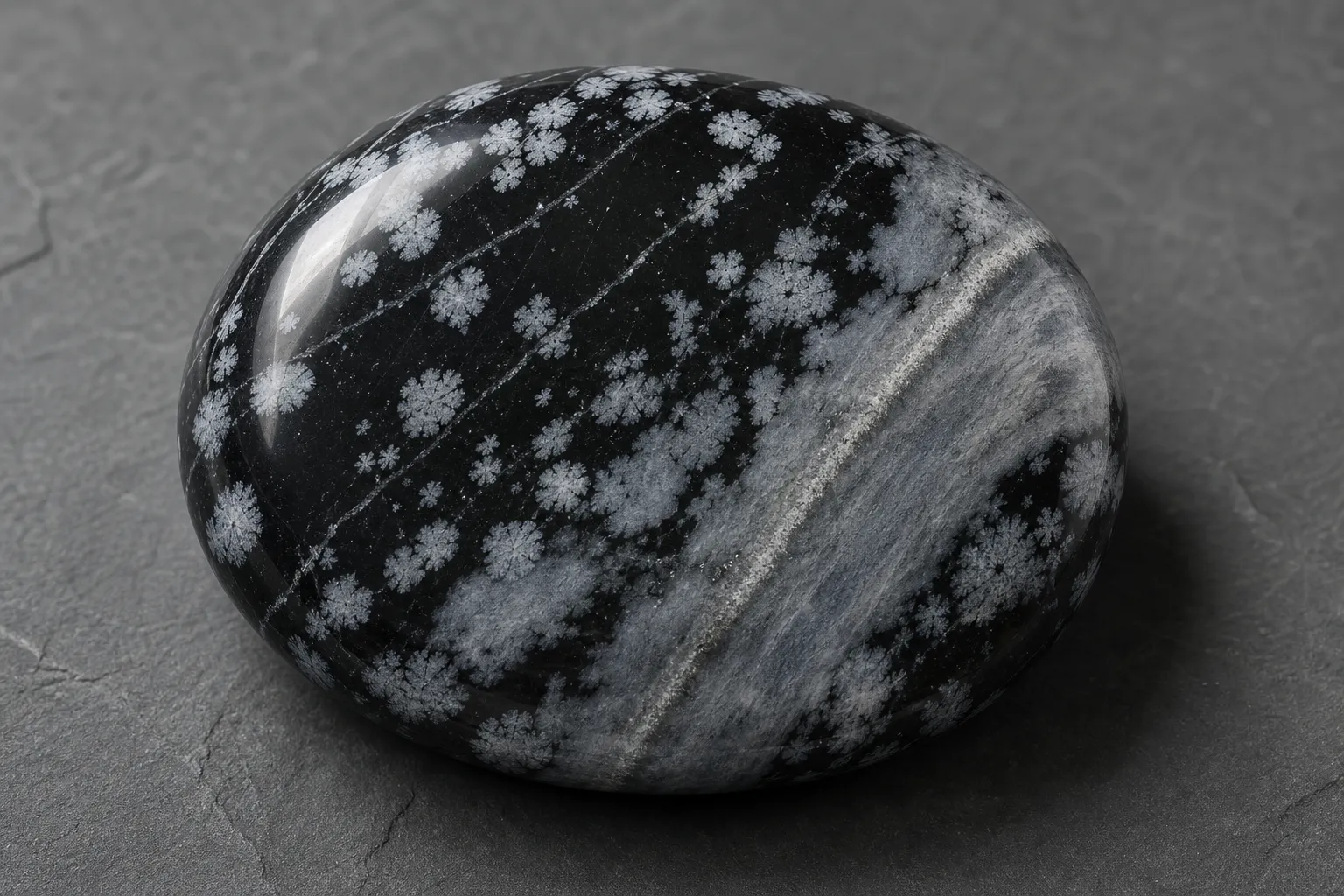
A polished snowflake obsidian surface does not always show neat white dots on black glass. Yes, snowflake obsidian can have lines, bands, cloudy patches, and uneven pale areas. A piece described as snowflake obsidian with lines is not automatically mislabeled.
The useful check is narrower: do the marks look like part of the stone’s visible pattern, a surface scratch, reflected light, residue, or a seller’s overconfident label? Lines, bands, and cloudy patches are clues. They do not prove authenticity, origin, value, or a precise variety name by themselves.
upward
Start with the broader guide
Use the broader guide first if you need the full scope before this page.
What Lines, Bands, and Cloudy Patches Can Look Like
On a dark glassy surface, lines may appear as pale streaks, gray trails, narrow seams, or breaks between lighter and darker areas. Some look sharper in photos than they do in hand because glare and contrast can harden a soft pale area into a “line.”
Bands are broader. A banded snowflake obsidian piece may show a stripe, flowing belt, or zone where pale patterning gathers across the polished face. In collector language, “banded” often describes what the eye sees; it is not automatically a separate formal category.
Cloudy patches are softer. Cloudy snowflake obsidian may show gray-white misty areas, blurred clusters, or pale zones that do not form crisp snowflake spots. A cloudy patch can sit beside sharper spots, or it can dominate one side of a cabochon, bead, palm stone, or carving.
Lines
Narrow streaks, seams, trails, or pale breaks. Read them as a pattern cue, not proof of source.
Bands
Wider zones or stripe-like areas. They are useful descriptions, but naming can vary.
Cloudy patches
Soft gray-white areas or blurred clusters. They are worth noting, but not enough for a conclusion.
Mixed patterning
Spots plus streaks, bands, or cloudy zones. Inspect the full piece before trusting one label.
A single surface can show more than one pattern type. Snowflake obsidian visible patterns are often less tidy than product photos suggest.
Why the Same Piece Can Look Different in Photos
Lighting changes the pattern. Bright light can make pale areas jump forward; dim light can flatten them. A phone camera may sharpen edges, darken the background, or make gray patches look whiter than they appear in person.
The polish angle matters too. On a glossy curved surface, reflected light can hide part of the pattern or create a bright streak that resembles a line. Turn the piece slightly. If the “line” moves with the reflection, it may be glare rather than an internal-looking feature.
Image quality adds another limit. A close-up may show pale inclusions clearly, but it can remove scale. A full-piece photo gives better context, but it may miss faint cloudy areas.
If you are judging from images, ask for:
- A photo in indirect natural light.
- A second angle with less glare.
- One full-piece view and one closer pattern view.
- An edge, chip, or unpolished area if available.
- Plain label wording that does not turn the pattern into certainty.
Better photos improve inspection. They still do not verify a specimen on their own.
When Patterned Areas Are Useful Clues
Patterned inclusions in obsidian can help you describe what you are seeing, but the wording should stay close to the surface: pale spots, gray-white clusters, cloudy areas, lines, bands, and contrast against a dark glassy base.
A collector can reasonably write “snowflake obsidian with lines” when the piece has a dark base, pale snowflake-like areas, and additional streaking or banding. That is a visual description. It should not be stretched into a claim about rarity, source, or formation history without stronger support.
Look across the whole piece
- Do the pale areas appear within the stone rather than only on the surface?
- Do the lines connect naturally with nearby patterning?
- Could the mark be a scratch, residue, coating, or reflection?
- Do cloudy patches remain visible when the stone is turned under softer light?
- Does the whole piece still read as snowflake obsidian, not just one attractive spot?
The safest habit is to describe before naming. “Black polished stone with gray-white patches and pale streaks” is more useful than forcing a confident variety label too early.
What Lines or Bands Do Not Prove
Lines in snowflake obsidian can be interesting, but they do not prove that a specimen is older, rarer, more desirable, or from a particular locality. Bands also do not confirm a special category unless the source supports that label with more than appearance.
This is where many listing misunderstandings begin. Words such as “banded,” “cloudy,” “patterned,” or “with lines” may be honest visual shorthand, but they can also be used loosely. A variety name is not the same as verification.
Authenticity patterns are easy to overread. A real-looking snowflake pattern does not prove the entire identity of a piece from one photo. An unusual line, band, or cloudy area also does not make the stone false. Both conclusions need more than one dramatic mark.
Pattern meaning needs the same restraint. Some collectors attach personal or cultural meaning to the contrast between dark glass and pale markings. That can be part of someone’s interpretation, but it is not a measurable result attached to the stone.
For identification notes, stay with what can be inspected:
- Base color and glassy luster.
- Pale pattern shape and distribution.
- Surface polish, glare, and scratches.
- Edges, chips, or fracture areas if visible.
- Seller wording and how cautious it is.
- Whether the label depends on one photo.
A confident label should not rest on a single attractive patch.
How to Inspect a Snowflake Obsidian Piece With Lines
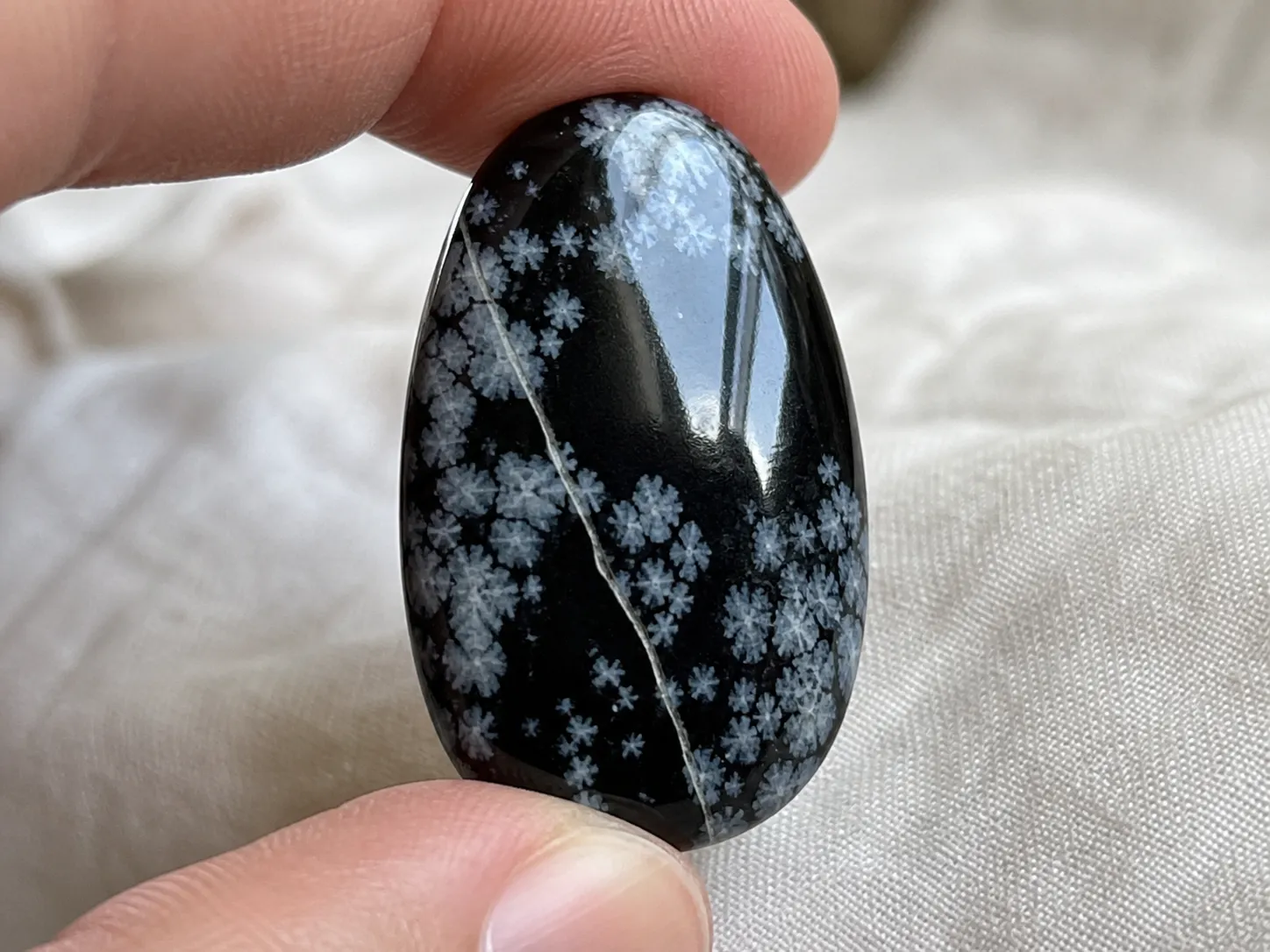
Start with clean, indirect light. Place the piece on a neutral surface and turn it slowly. If a line stays in the same place while the reflection moves, it is more likely part of the visible pattern or surface condition. If it moves with the light, treat it as possible glare.
Next, compare the line with nearby pale areas. Patterning often has irregular edges, changes in density, and some relationship to surrounding spots or cloudy patches. A scratch may cut across the polish more sharply. Residue may sit unevenly on the surface and may change after gentle cleaning. Avoid scraping; obsidian is glassy, and chips or sharp edges deserve careful handling.
Then step back. A close-up can make a tiny mark seem important. The full-piece view tells you whether the specimen reads as snowflake obsidian overall, as a dark stone with a few pale marks, or as something too uncertain to label from images.
For a seller listing, cautious wording is a good sign. “Snowflake obsidian with pale lines and cloudy patches” is more useful than wording that turns every visible feature into certainty about source, worth, or special status.
A simple inspection path works well:
- Check the piece in indirect light.
- Rotate it to separate glare from pattern.
- Look at the full surface, not only the strongest mark.
- Note whether lines, bands, and cloudy patches blend with the pale areas.
- Keep the label provisional if you only have photos.
That is enough for a practical next step: ask for better images, record the visible traits, or avoid relying on the label alone.
When to Use “Banded” or “Cloudy” in Your Notes
Use “banded” when pale areas form a noticeable stripe, zone, or repeated belt across the specimen. Use “cloudy” when the pale pattern is soft, misty, or diffuse rather than crisp. Use “with lines” when narrow streaks or seams are visible enough to help describe the piece.
These words are useful collection notes, not final classifications. A tray label such as “polished snowflake obsidian, dark base, cloudy gray-white patches, faint pale banding” gives more information than a dramatic name with no visible description.
If you are comparing two pieces, describe the pattern before ranking them. One may have sharp white spots; another may have gray cloudy patches and bands. Neither description alone establishes better quality. It tells you what the eye can inspect.
The Short Collector Answer
Snowflake obsidian can have lines, bands, and cloudy patches. Those features may be part of the visible pattern, emphasized by polish and lighting, or made unclear by photo quality. They are worth noting, but they should not be used alone to prove authenticity, origin, value, or a precise variety label.
If the pattern remains visible from several angles and fits the overall look of the piece, “snowflake obsidian with lines,” “banded snowflake obsidian,” or “cloudy snowflake obsidian” can be a reasonable visual description. Keep the wording descriptive, ask for better photos when needed, and let the surface carry more weight than the label.