
Collector identification note
What Do Bubbles and Tiny Specks in Obsidian Mean
Bubbles in obsidian usually point to one of two possibilities: they may be natural trapped vapor or gas features from volcanic glass formation, or they may be a reason to inspect the piece more carefully because other glassy materials can also contain bubbles.
Tiny specks work the same way. They can be natural internal features, such as devitrification spots, microscopic crystals, mineral impurities, or flow-related textures. But specks do not identify a stone by themselves.
The useful short answer is this: bubbles and tiny specks can be normal in obsidian, but they are not a stand-alone test for whether a piece is real, rare, valuable, or correctly named.
upward
Start with the broader guide
Use the broader guide first if you need the full scope before this page.
Tiny bubbles can occur in natural obsidian
Obsidian is natural volcanic glass. It forms from silica-rich volcanic magma that cools quickly enough to remain glassy instead of developing large visible crystals. That is why obsidian often looks smooth, glossy, and glass-like rather than grainy.
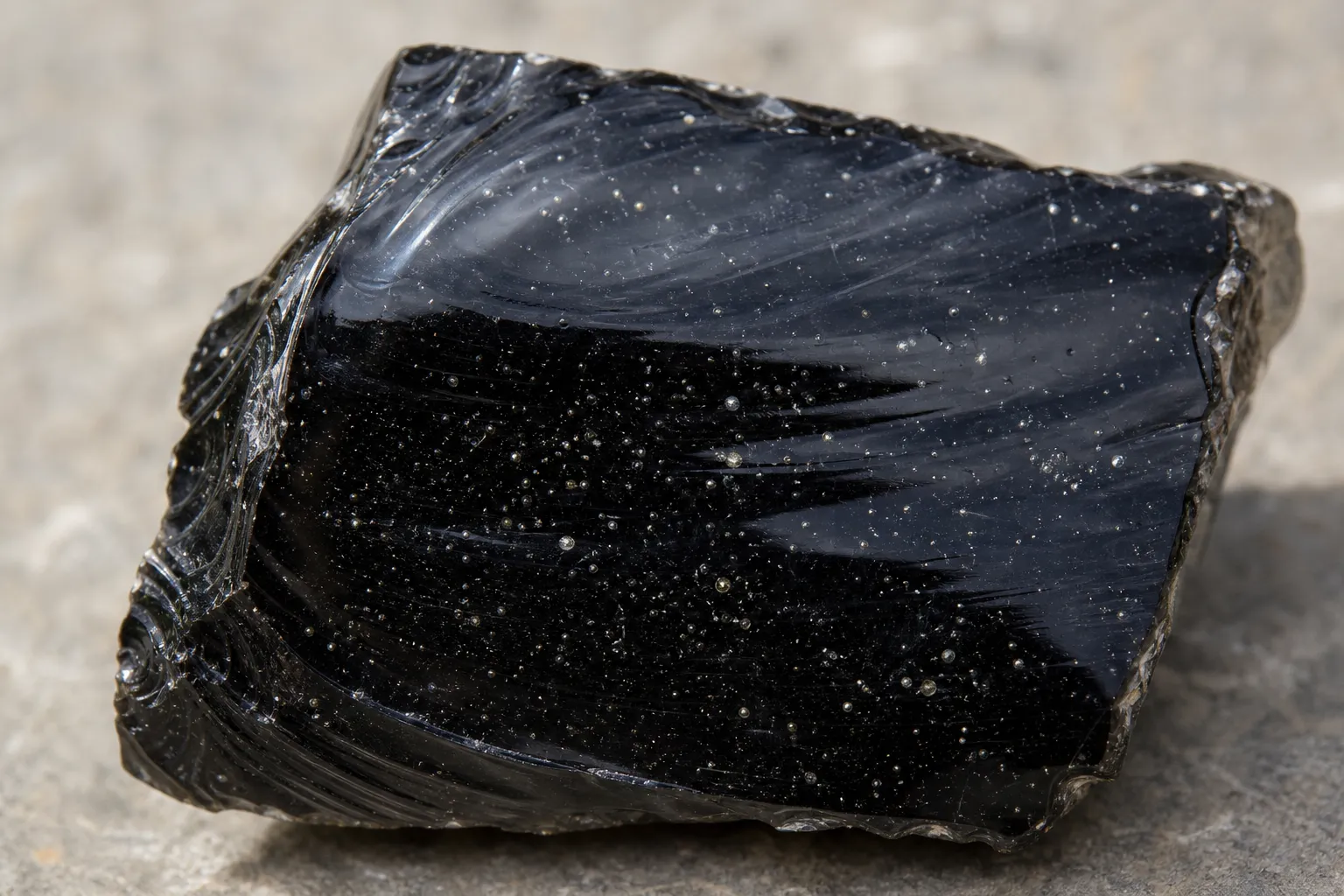
Within that glass, very small vapor or gas bubbles can be trapped. Some are visible in a polished or translucent piece. Others only show under strong magnification.
For collectors, the key point is simple: tiny bubbles in obsidian are not automatically suspicious. The common rule that “obsidian never has bubbles” is too broad. Natural obsidian can contain small internal bubbles, and those bubbles may be part of its original volcanic texture.
What matters is how the bubbles look.
Check these bubble traits
- Size: Are they tiny pinpoints, or large round cavities?
- Shape: Are they flattened, stretched, oval, spherical, or irregular?
- Amount: Are there a few scattered bubbles, or is the piece packed with them?
- Alignment: Do they follow bands, streaks, or a directional pattern?
- Context: Is the piece tied to a known volcanic obsidian source, or is it an unknown glassy object with a dramatic sales name?
Tiny, sparse, stretched, or flattened bubbles can be consistent with natural obsidian. Large, round, abundant, frothy, or very uniform bubbles deserve a closer look, especially when the material is unusually bright, transparent, aqua, blue-green, or sold as a rare variety without clear source context.
What flattened bubbles and flow layers can suggest
Some obsidian is not evenly black. It may show bands, smoky streaks, golden flash, silvery flash, or shifting reflectance when turned under light. These effects can relate to flow layers and microscopic internal textures.
In some sheen obsidian, tiny gas bubbles are stretched nearly flat along flow layers. When light hits those aligned internal features at the right angle, the stone may show gold or silver sheen. The effect usually is not visible from every direction. It often appears only when the surface, light, and viewing angle line up.
So the feature to notice is not just “bubbles.” Look for small flattened bubbles or internal layers arranged in a direction.
Thin streaks or flattened ovals may be flow-aligned bubbles.
Flash that appears only at certain angles may come from internal reflectance rather than surface color.
Visible bands may guide the direction of bubbles or specks.
A polished surface often makes sheen easier to see than a rough surface.
This does not mean every shiny black stone with bubbles is sheen obsidian. It only means flattened bubbles along flow layers are one natural mechanism that can fit some sheen varieties.
Tiny specks in obsidian have several possible causes
Sellers and collectors describe tiny specks in obsidian with many words: inclusions, snowflakes, glitter, flecks, crystals, dots, ash, or impurities. Those words are useful for describing what you see, but they are not all the same thing.
Pale gray or white snowflake-like patterns may be consistent with snowflake obsidian. In that variety, the familiar “snowflake” appearance is associated with devitrification, where volcanic glass begins to rearrange into crystalline material.
But not every pale speck makes a piece snowflake obsidian. A single dot, a cloudy patch, or a few random light flecks need more context. Pattern matters.
Questions to ask about specks
- Do the specks form rounded or radiating snowflake-like clusters?
- Are they spread through the glass or limited to one area?
- Are they white, gray, tan, black, metallic, or glitter-like?
- Do they follow flow bands?
- Are they inside the stone, on the surface, or caught in scratches and polish marks?
Other specks may be microscopic crystals, mineral impurities, microlites, flow-related features, or part of a seller’s variety description. For a collector, the practical translation is: a speck is a visible clue, not a final identity label.
When bubbles are a caution sign
Because obsidian is volcanic glass, it can be confused with other glassy materials in photos or marketplace listings. Manufactured glass, slag glass, and other glass-like materials can also contain bubbles. That is why bubbles do not confirm that a piece is natural obsidian.
Bubble pattern can still help you decide when to slow down.
Be more cautious when you see
- Large round bubbles scattered through a glassy object
- Many bubbles of similar size arranged in a very regular way
- Frothy or foamy texture throughout the piece
- Bright transparent blue, aqua, green, yellow, or red glass sold as obsidian without clear locality or geologic context
- Backlighting used as the main proof of identity
- Sales language built around rarity rather than careful description
This is not a rule that large bubbles always mean “not obsidian.” Unusual natural material with large oriented cavities has been described in gemological reporting, including material marketed as “bubble obsidian.” But that is a narrow example, not a universal rule for every bubbly glass object.
A better collector conclusion is: large or abundant bubbles make the piece worth checking more carefully, especially if the color, transparency, or seller label already seems unusual.
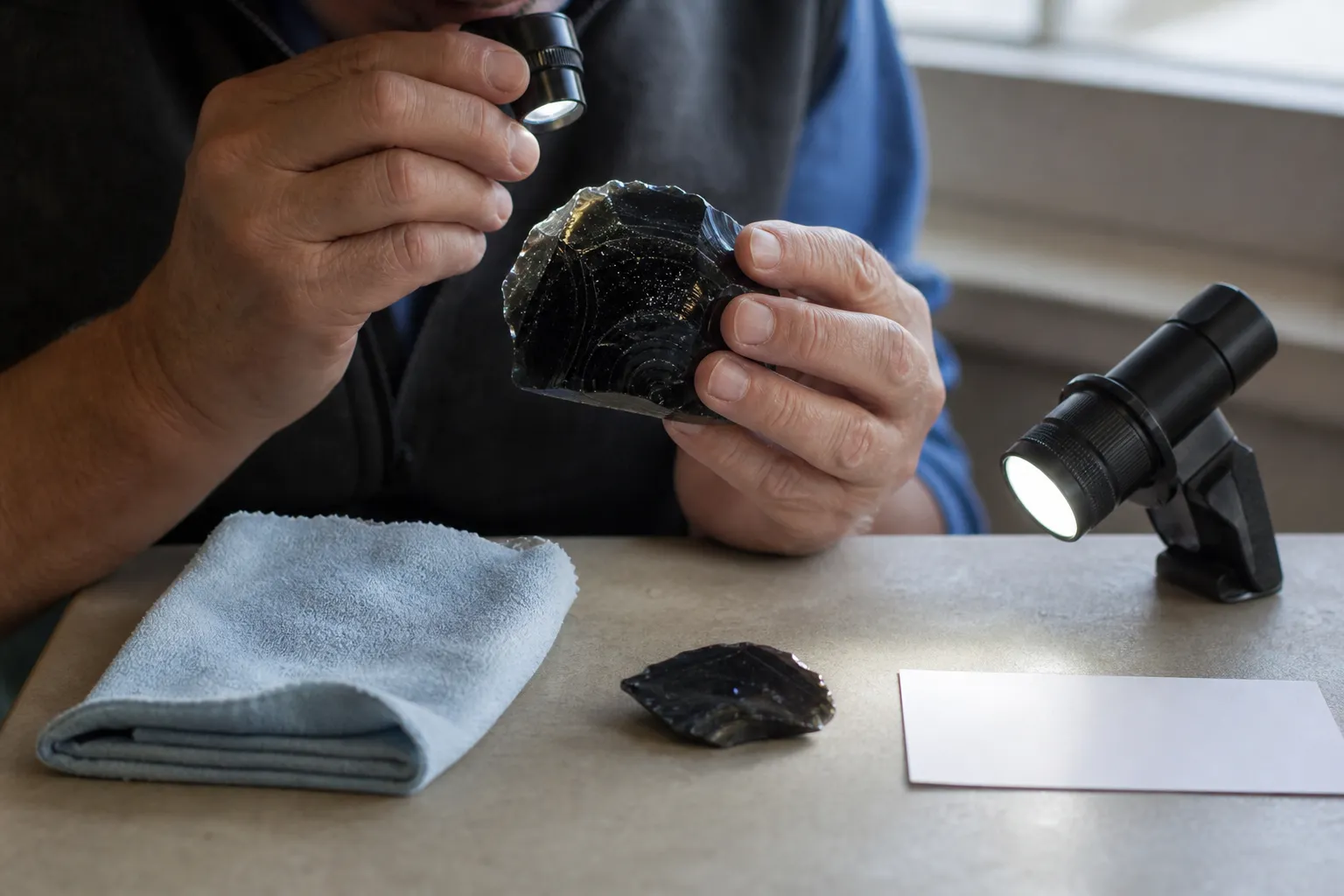
How to inspect bubbles and specks without overreading them
You do not need destructive tests to make a better first observation. Start with clean, careful viewing and context.
Use this simple path:
-
1. Clean the surface gently. Dust, wax, fingerprints, polish residue, and tiny chips can imitate internal specks.
-
2. Look under normal light before backlighting. Strong backlighting can exaggerate color and make ordinary glass look more dramatic.
-
3. Tilt the piece slowly. Watch whether bubbles, sheen, or specks line up with bands.
-
4. Use magnification if available. A hand lens can help separate surface marks from internal features, but it is only an observation aid.
-
5. Compare bubble character. Tiny, flattened, flow-aligned bubbles tell a different story from large, round, numerous bubbles.
-
6. Check source context. A known volcanic obsidian locality is more meaningful than a vague label on a bright glassy object.
-
7. Avoid one-clue conclusions. Bubbles, specks, color, transparency, polish, and provenance need to be read together.
Photos can be misleading. Exposure, backlighting, white balance, and reflections may make a dark green or black glassy piece look aqua, electric blue, or unusually transparent. A photo can support a cautious first impression, but it cannot settle every obsidian-versus-artificial-glass question.
For a high-value purchase, a dispute, or an unusual color claim, visual inspection is only a starting point. A gemologist, geologist, or qualified lab can help if authenticity or value matters.
What bubbles and specks cannot tell you by themselves
Bubbles and specks are useful because they give you something visible to inspect. Their limit is that several materials and processes can produce similar-looking features.
They cannot show, on their own:
- that a piece is natural obsidian;
- that a piece is artificial glass;
- that a seller’s variety name is correct;
- that the stone is rare;
- that it came from a specific locality;
- that a photo-only identification is reliable;
- that the object is suitable for every type of handling or use.
They also do not replace basic handling care. Obsidian can break with conchoidal fracture, creating very sharp edges. Rough, chipped, broken, or knapped pieces should be handled with attention to edges, whether or not they have bubbles or specks.
Quick collector read
If you are holding a piece now, read the features this way:
- A few tiny bubbles: can be normal in obsidian.
- Flattened bubbles following bands: may fit flow layers or sheen obsidian.
- Gold or silver flash at certain angles: may relate to aligned tiny bubbles in the glass.
- White or gray snowflake-like specks: may be devitrification features, especially in repeated clustered patterns.
- Large, round, abundant bubbles: a caution sign, not an automatic verdict.
- Bright transparent aqua or blue-green glass with bubbles: check the source context carefully before accepting an obsidian label.
- One photo or one clue: not enough for confident identification.
Bubbles and tiny specks in obsidian are best treated as internal features to describe carefully. They can tell you what to inspect next, but they should not be asked to answer more than they can.