Collector evidence guide
What Provenance Means for an Obsidian Specimen
A glossy black surface may suggest obsidian, but it cannot tell you where a particular piece came from or who handled it before you acquired it. Obsidian provenance is the documented story attached to one specimen: its stated locality or source area, collection history, ownership history, and the records connecting those details.
Direct answer
Provenance provides context about a specimen’s stated locality and collection or ownership history. It does not, by itself, establish authenticity, exact geological origin, or a complete chain of ownership.
First inspection point
Ask what exactly is recorded, and which document connects one part of the story to another.
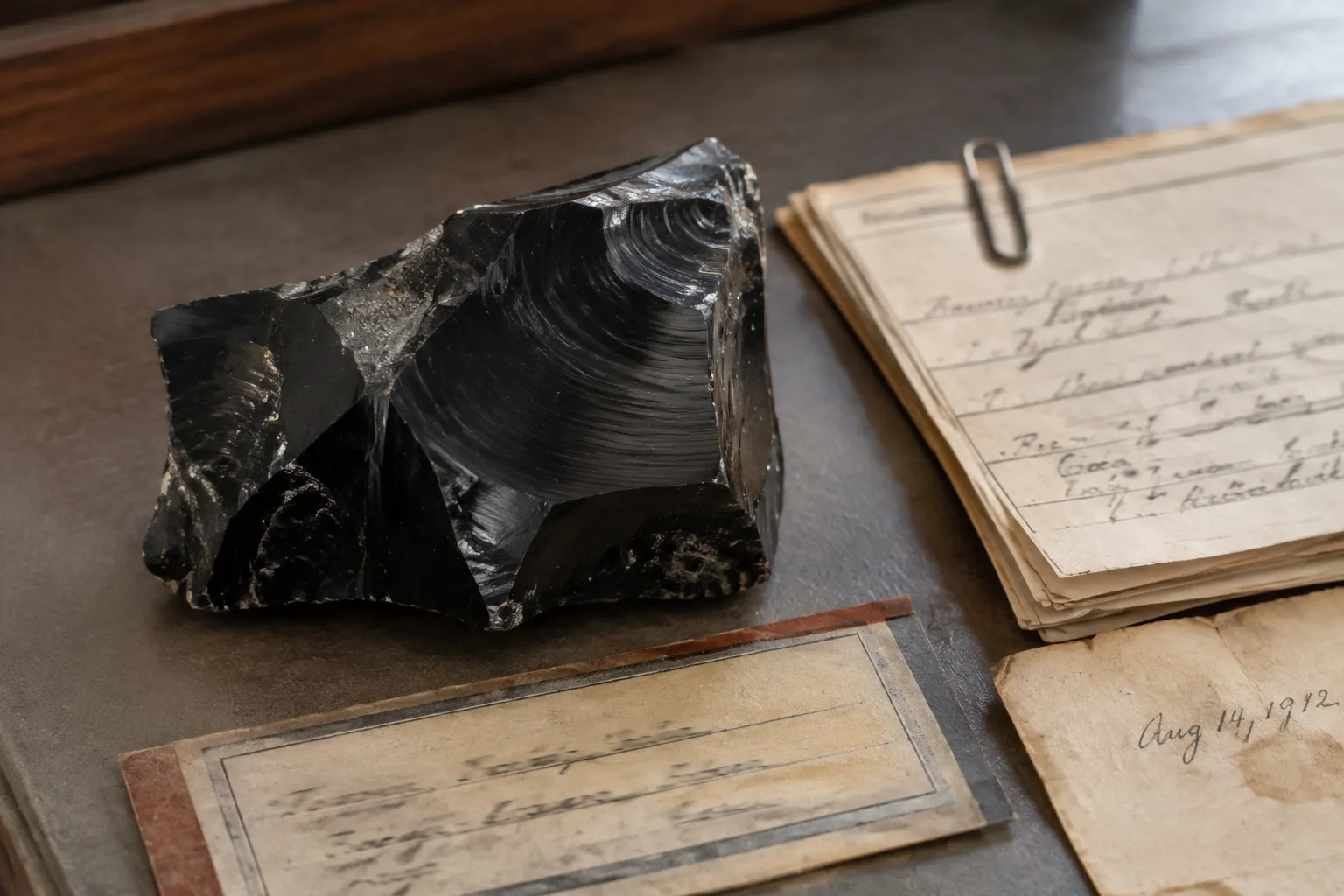
A seller’s label may provide a locality claim. A catalog entry, field record, dated invoice, institutional record, or named previous owner may add traceability. The more specific and connected the documentation is, the clearer the specimen’s history becomes.
That history still has limits. Provenance provides context; it does not by itself establish the specimen’s authenticity, exact geological origin, or a complete chain of ownership. A plausible source area is not the same as a documented origin for the individual piece.
upward
Start with the broader guide
Use the broader guide first if you need the full scope before this page.
What an Obsidian Provenance Record Can Contain
For a collector, provenance is more than a place name written on paper. It is the relationship between the specimen and the information recorded about it.
Stated locality
The place where the piece is said to have been collected or sourced.
Geological source area
The broader volcanic or regional setting associated with that locality claim.
Collection history
Information about when, where, or by whom the specimen entered a collection.
Ownership history
Named previous owners, dealers, institutions, or collections connected to it.
Catalog records
An entry identifying the specimen and preserving related notes.
Field records
Documentation associated with collecting at or near a named place.
Purchase or transfer records
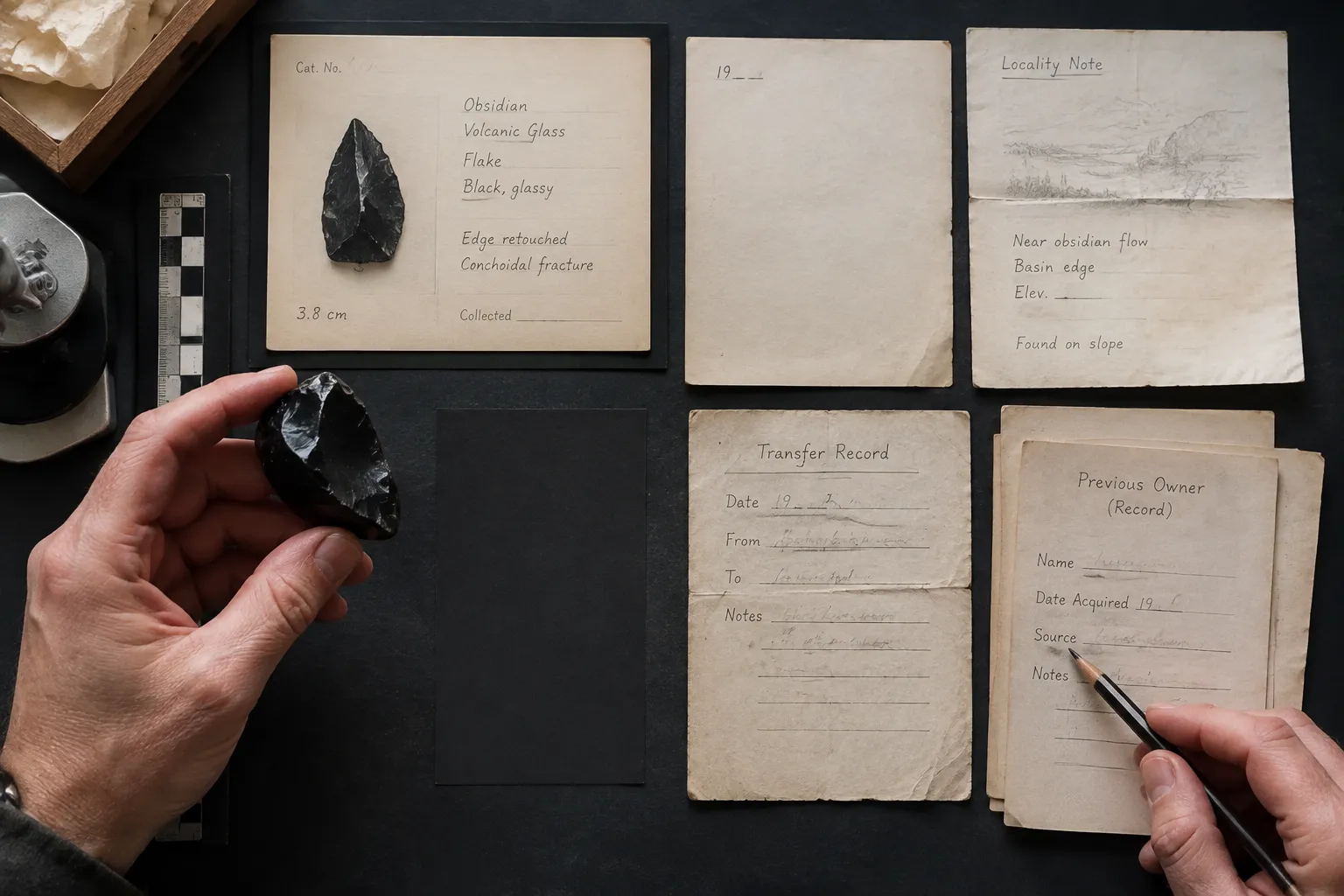
Invoices, dated labels, correspondence, or other documents linking one holder to the next.
These elements do not carry identical weight. A handwritten label marked “locality unknown” tells you something different from a label naming a locality and matching a dated collection record. Neither should be described more strongly than the record allows.
Museum collections offer a useful comparison. Their cataloging systems are designed to keep specimen identity, locality, and collection information connected. The Smithsonian’s Mineral Sciences collections show how organized catalog records can make an object’s history easier to follow. That example explains the value of connected documentation; it is not a universal provenance standard for privately owned obsidian, and it does not settle the history of a specimen outside that collection.
The practical question is simple: what exactly is recorded, and which document connects one part of the story to another?
How Strong Is the Documentation?
When reviewing an obsidian specimen history, separate the claim from the record supporting it. A simple way to do that is to move from a stated locality toward a more connected history.
A label or seller statement
At the most basic level, the locality is simply stated. The wording may appear on a shop listing, paper label, collection note, or invoice. It might name a region, volcanic field, or source area.
This information can still be useful, especially when it is specific and has stayed with the piece. But “the label states” is more accurate than “the specimen came from.” A seller’s locality statement is not automatically a documented specimen history.
Market terms such as “collector provenance,” “original locality,” or “documented origin” can sound more conclusive than the paperwork behind them. Look past the label and ask what the wording is based on.
A catalog entry or field record
A catalog entry or field record adds structure. It may connect a specimen number, locality, description, and collection history, or preserve information associated with collecting at a named place.
That allows a more useful question than simply asking whether a locality name appears: does the record identify the same piece, collection, or transfer described by the seller?
The available sources do not establish one obsidian-specific format that every private collector must follow. They support a narrower point: a specimen history is easier to follow when locality, identity, and collection details remain connected.
A traceable collection or ownership history
A fuller provenance context may link several stages, such as collection or acquisition, a named previous owner, a dealer or institution, and the present holder. Each link should be described as documented rather than assumed.
A connected history might include dated records, matching labels, catalog references, or transfer documents. Gaps can remain. A long list of names is not especially meaningful if the documents do not identify the same specimen or if the links between holders are unclear.
Useful wording
- “The available record traces the piece to…”
- “The specimen is documented as coming from…”
- “The label and catalog entry provide provenance context.”
- “The ownership history is incomplete after…”
Provenance describes how well the history is recorded. It is not, by itself, a laboratory conclusion about the material.
What Geological Context Can and Cannot Establish
Obsidian is volcanic glass, and geological information can explain why a stated locality matters. A source area may have geological characteristics associated with obsidian, giving a locality claim a plausible regional context. The U.S. Geological Survey’s material on volcanic glass and obsidian provides that kind of background.
Evidence boundary
Geological plausibility does not connect an individual specimen to that location.
A piece may resemble material associated with a named source area, yet appearance alone cannot establish its collection history. Lighting, polish, surface treatment, sheen, color bands, and inclusions can all affect how a specimen is described. Even a close geological match remains context unless the specimen’s own records link it to the source area.
Identification
What material or visible variety might this be?
Locality
Where is the piece said to have come from?
Provenance
How are the locality and ownership details documented?
Authentication
What separate evidence supports the identity and history of this specific specimen?
A catalog record can preserve a claim without independently confirming every part of it. A geological source-area match can make a locality worth investigating without resolving the specimen’s history.
Treat geology as context, not as a substitute for specimen-level documentation.
Common Provenance Confusions
“The locality is specific, so the provenance is strong.”
Specificity helps, but it is only one part of the picture. “A volcanic area in a named region” and “a specimen linked to a dated field record from a named locality” are different kinds of information.
Record the exact wording. Note whether the locality is printed, handwritten, repeated across documents, or supplied only in a current listing. A precise claim with no visible supporting record should remain a stated locality.
“A catalog number confirms the exact origin.”
A catalog number can help identify an object within a collection, particularly when it is connected to a description, locality, and collection history. It does not automatically show that the piece was collected where the label says, or that the number belongs to the same object now in hand.
Check for continuity. Does the number match the label, photograph, dimensions, or collection description? If not, describe the connection as uncertain.
“A geological match confirms the specimen.”
It does not. A source area may be geologically plausible while the individual piece remains undocumented. Visible traits can guide comparison, but a photograph or surface resemblance cannot establish a complete origin history.
“More paperwork always means better provenance.”
Documentation is useful when it is specific, connected, and attributable to the specimen. Repeated copies of the same unsupported seller statement do not create an independent history. Several vague labels may still leave the central question open.
“Provenance establishes value or authenticity.”
The available material does not support appraisal conclusions, market valuation, or specimen-specific authentication. Provenance may help a collector understand a piece’s history, but that is different from confirming exactly what the material is or assigning it a price.
How to Describe an Uncertain Record
A clear private record does not need inflated language. Start with the strongest statement the documents support, then name the gap.
The specimen is labeled as coming from a named locality. A dated purchase record links it to the previous owner, but no field record or earlier collection document is available.
This separates the stated locality from the documented ownership link. It also makes the missing evidence visible.
The available documents connect the specimen to a named locality, a catalog entry, and a prior collection. The record supports provenance context, while the exact collection event and geological origin remain unverified from the available material.
When reviewing your own piece, ask:
- 1. What locality is stated?
- 2. Is the source area specific or broad?
- 3. Who supplied the locality information?
- 4. Is there a catalog entry, field record, invoice, or dated label?
- 5. Does the document identify this specimen, or only a similar piece?
- 6. Are previous owners or collections named?
- 7. Where does the documented history stop?
- 8. Which parts are records, and which parts are assumptions?
Keep those answers with the specimen. Photograph the label, preserve the invoice, record any catalog number, and note gaps in the history. These steps organize the available information; they do not turn an uncertain origin into a confirmed one.
The Short Answer
For an obsidian specimen, provenance means the traceable documentation surrounding its stated locality and history of collection or ownership. A seller label is a claim. A catalog entry or field record adds documentation. A connected collection history provides stronger provenance context. None of these, on its own, establishes the specimen’s authenticity or exact geological origin.
Use the most accurate label the record supports: stated locality, documented collection history, partial ownership history, or uncertain origin. Look at the paper trail before the promise attached to it.