
Volcanic glass formation
Where Does Obsidian Form Around a Volcano
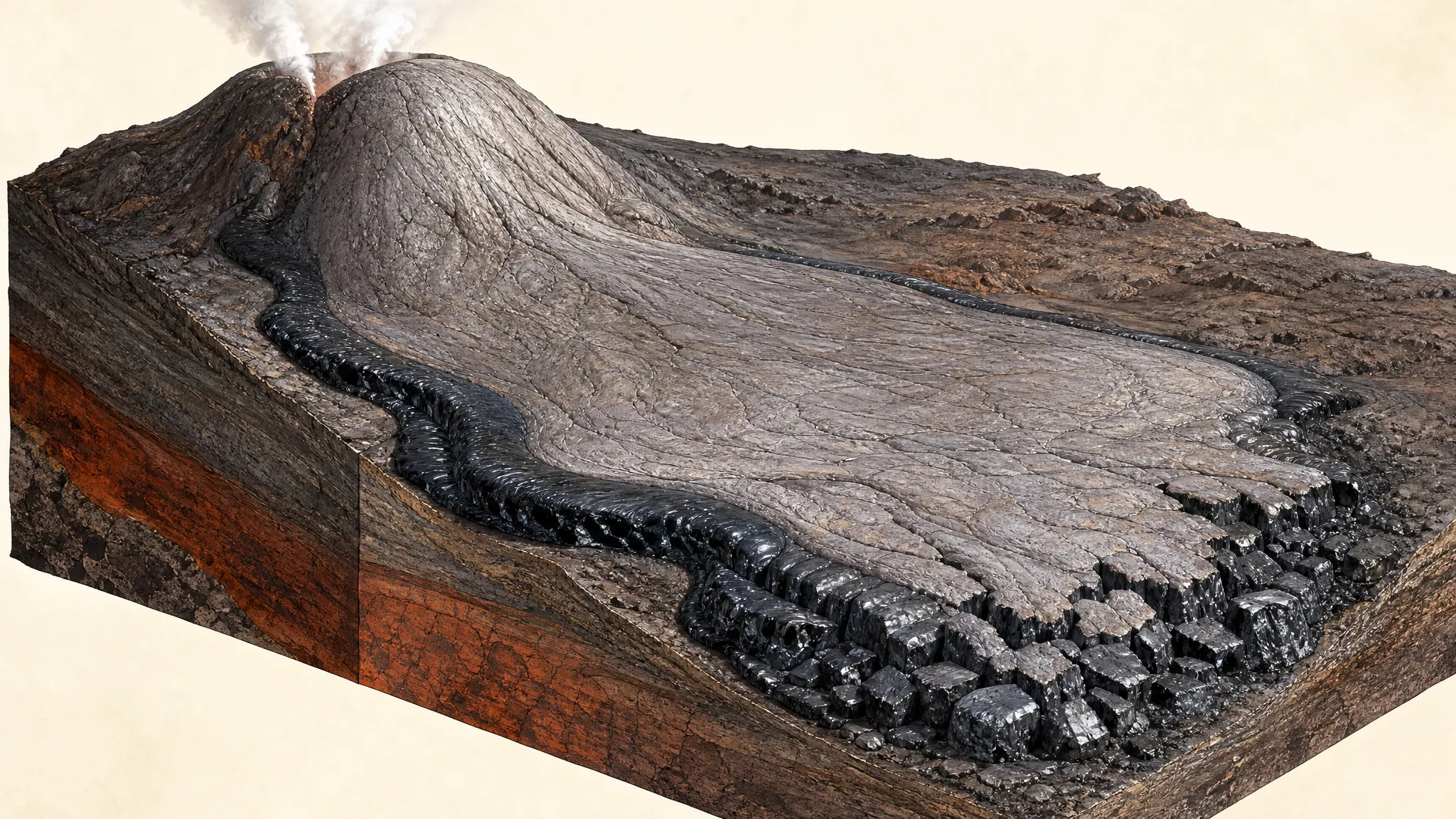
Obsidian forms around a volcano where silica-rich volcanic melt cools quickly enough to become glass instead of growing visible crystals. In practical field terms, the best places to picture are old lava-flow surfaces, flow edges, flow fronts, chilled margins, and viscous volcanic domes near vents.
It is not usually a neat “crystal pocket” inside a volcano. The pieces people notice later are more often glassy bands, angular blocks, chips, or weathered fragments that broke away from those original cooling zones.
The exact location depends on the lava chemistry, eruption style, cooling conditions, and what later erosion has exposed or moved.
Quick answer
Picture obsidian at fast-cooling edges and contacts of suitable lava: flow surfaces, margins, fronts, chilled boundaries, and dome-related blocks near vents.
upward
Read the full overview first
Use the broader guide first if you need the full scope before this page.
The main places obsidian forms around a volcano
Obsidian is volcanic glass. Its texture comes from rapid cooling and limited visible crystal growth, not from the slow growth pattern of many collectible minerals.
Around a volcano, the most useful formation zones are places where hot lava meets cooler surroundings:
| Volcanic setting | What it means | What may be visible later |
|---|---|---|
| Lava-flow surface | The outer part of a lava flow exposed to air | Glassy patches, flow bands, broken plates, weathered crust |
| Flow edge or margin | The side of a flow against air, ground, older rock, or another cooler surface | Chilled glassy zones, fractured pieces, angular blocks |
| Flow front | The leading end of a moving lava flow | Rubble, broken blocks, folded or banded glassy surfaces |
| Chilled contact | A boundary where hot volcanic material cooled quickly | Dense glassy texture, sharp breaks, transitions into stonier rock |
| Volcanic dome | A mound-like buildup of thick lava near a vent | Obsidian bands, blocky surfaces, fragments shed from the dome |
| Eroded deposit | Material broken from the original lava body and moved or exposed later | Chips, weathered pieces, mixed volcanic rubble |
These settings often overlap. A dome may have flow-like lobes. A lava flow may have a glassy upper surface, blocky sides, and a chilled base. The key is not one magic spot on the volcano, but the combination of suitable lava and fast enough cooling.
Why flow edges and flow fronts matter
When people ask where obsidian forms, they often picture the crater first. The vent area can matter, especially with dome-forming eruptions, but old lava flows are usually easier to understand.
A lava flow has hotter inner zones and cooler outer zones. The outside loses heat faster because it is exposed to air, ground, older rock, or other cooler material. In silica-rich lava, that faster cooling can preserve a glassy texture. That is why obsidian is so often associated with lava-flow edges, chilled margins, flow surfaces, and flow fronts.
The flow front is important because it is the advancing end of the lava. In thick, viscous lava, the front can break, fold, pile up, and expose fresh surfaces as the flow moves. After the eruption, those broken zones may remain as angular glassy blocks or chips.
Visual signs that matter more than “black rock”
For a beginner, the clue is not simply “black rock near a volcano.” Better visual signs include:
- Glassy luster on a fresh surface
- Curved, shell-like conchoidal fracture
- Sharp angular breaks
- Flow banding or streaky internal layers
- Dense glassy areas beside frothy or stony volcanic material
- A dull weathered outside with fresher glass visible on a broken edge
Those traits can support an obsidian identification, but they do not prove an exact source by themselves.
Obsidian around volcanic domes
Volcanic dome obsidian is another useful mental image. A dome is a mound-like buildup of viscous lava near a vent. Silica-rich lava can be thick and resistant to flowing far, so it may pile up into domes or short, heavy flows instead of spreading out like thinner basaltic lava.
In dome settings, obsidian may occur as glassy bands, blocks, and chilled zones within or around the lava body. Public geology sources describe obsidian-bearing domes and rhyolitic lava flows in volcanic regions such as the western United States. These examples show that obsidian can be part of a larger lava body, not a separate mineral vein.
A dome can also look less “glassy” than expected from a distance. Its surface may be rough, gray, brown, blocky, or weathered. Fresh breaks may show the glassy interior more clearly than the outer crust. Some pieces may include banding, bubbles, or zones that look more stony. That variation does not automatically rule out obsidian; glassy volcanic bodies can vary across a flow or dome.
For collectors, the useful takeaway is simple: obsidian around volcanic domes is often found as broken material from a glassy lava body, not as tidy crystals attached to cavity walls.
Chilled margins, blocks, chips, and weathered pieces
“Chilled margin” is a helpful term because it describes both a process and a place. It means an edge or boundary of hot volcanic material that cooled relatively quickly against something cooler. Around a volcano, chilled margins can occur along the top, sides, base, or front of a lava body.
Over time, those glassy areas can crack. Obsidian breaks with curved, shell-like fracture surfaces, and fresh edges can be very sharp. From a collecting point of view, that matters because a loose piece may have traveled away from the original cooling surface.
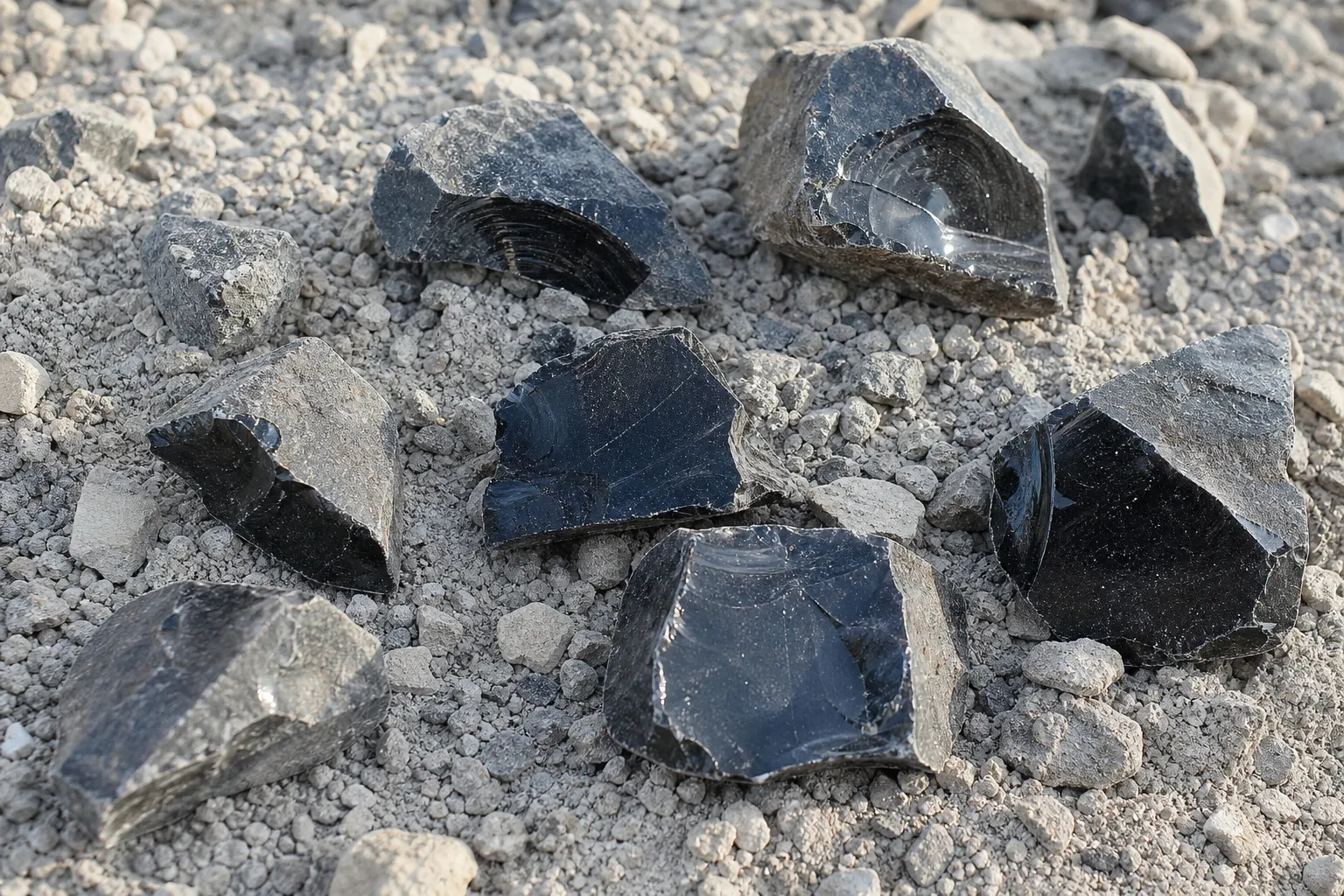
A fragment on a slope, in a wash, or among volcanic rubble may have come from an older flow or dome upslope. It may not mark the exact place where the glass first formed. Weathering can dull the surface, hydration can alter the outer skin, and abrasion can round once-sharp edges. A piece may look gray, brownish, smoky, or matte outside while still showing a glassy interior on a fresh break.
This is also why color and polish have limits. A polished black, rainbow-sheen, or snowflake-patterned piece may be attractive, but polishing removes field context. Seller names and color labels usually describe appearance, not verified formation location. Exact origin usually needs locality information and, for serious sourcing, more than visual inspection.
What has to be true for obsidian to form
Not every volcano makes obsidian, and not every lava flow becomes glassy. Two things matter most: the material and the cooling history.
Obsidian is commonly associated with silica-rich volcanic material, especially rhyolitic compositions. This kind of lava can be viscous, meaning it does not flow as easily as thinner basaltic lava. If it cools in a way that prevents many visible crystals from growing, it can solidify as volcanic glass.
The phrase “rapid cooling obsidian” is useful, but it is not the whole story. Degassing, bubbles, flow deformation, cracking, and reheating or sealing of fractures can all influence the final texture in obsidian-bearing eruptions.
Keep the practical summary narrow
- Obsidian forms from natural volcanic melt.
- It is glassy because visible crystals did not develop before the material solidified.
- Lava chemistry matters, so dark volcanic rock is not automatically obsidian.
- Cooling is often fastest near surfaces and contacts.
- Later breakage and erosion can move pieces away from the original formation zone.
This also explains why obsidian may occur near other volcanic textures. Pumice, rhyolite, perlite, scoria, and other volcanic materials can appear in volcanic landscapes, but they do not all mean the same thing. Pumice is highly bubbly and light; obsidian is typically dense and glassy, though some obsidian-bearing deposits include bubbles, bands, or less glassy zones.
Common misunderstandings about where obsidian originates
Obsidian does not grow like a crystal
In collector language, obsidian is often grouped with crystals, but geologically it is volcanic glass. It does not form as a faceted crystal habit in an open pocket.
Not all lava becomes obsidian
Basaltic lava can cool into dark volcanic rock without becoming obsidian. The glassy texture depends on composition and cooling history.
Real obsidian is not made by pouring water on any lava
A third confusion comes from gaming and crafting language. Natural obsidian is not made by pouring water on any lava in a real-world setting. It comes from volcanic processes under the right material and cooling conditions.
Appearance alone does not identify the exact source
There is also a source-location problem. A glossy polished stone does not reveal its exact volcano, flow, or dome by appearance alone. Flow bands, sheen, snowflake-like devitrification, and color can help describe a specimen, but they are not complete source labels. Lighting, polish, weathering, inclusions, and seller naming can all affect what the piece appears to be.
The crater is not the only place to imagine
Finally, the crater is not the only place to imagine. In many obsidian-bearing volcanic systems, the more relevant features are old lava flows, domes, flow fronts, chilled margins, and eroded deposits.
The practical answer for collectors
If you are trying to picture where obsidian forms around a volcano, start with old silica-rich lava bodies rather than the volcano as a whole. Look conceptually to:
- The outer surfaces of obsidian-bearing lava flows
- The sides and fronts of thick flows
- Chilled margins where lava met cooler surroundings
- Domes or short thick lava bodies near vents
- Broken blocks and fragments from those glassy zones
- Weathered pieces exposed after erosion
That does not mean every volcanic area is open or appropriate for collecting. Active volcanic zones, protected lands, private property, and cultural sites may have restrictions or hazards. The better next step is to check local geological information, land-management rules, or documented locality notes instead of assuming any black glassy rock near a volcano is collectible obsidian.
In short: obsidian forms where suitable volcanic melt becomes glass, most visibly around lava-flow edges, flow fronts, chilled margins, and volcanic domes. The pieces people handle later are often fragments from those settings, changed by breakage, weathering, and time.