
What Are the White Spots in Snowflake Obsidian
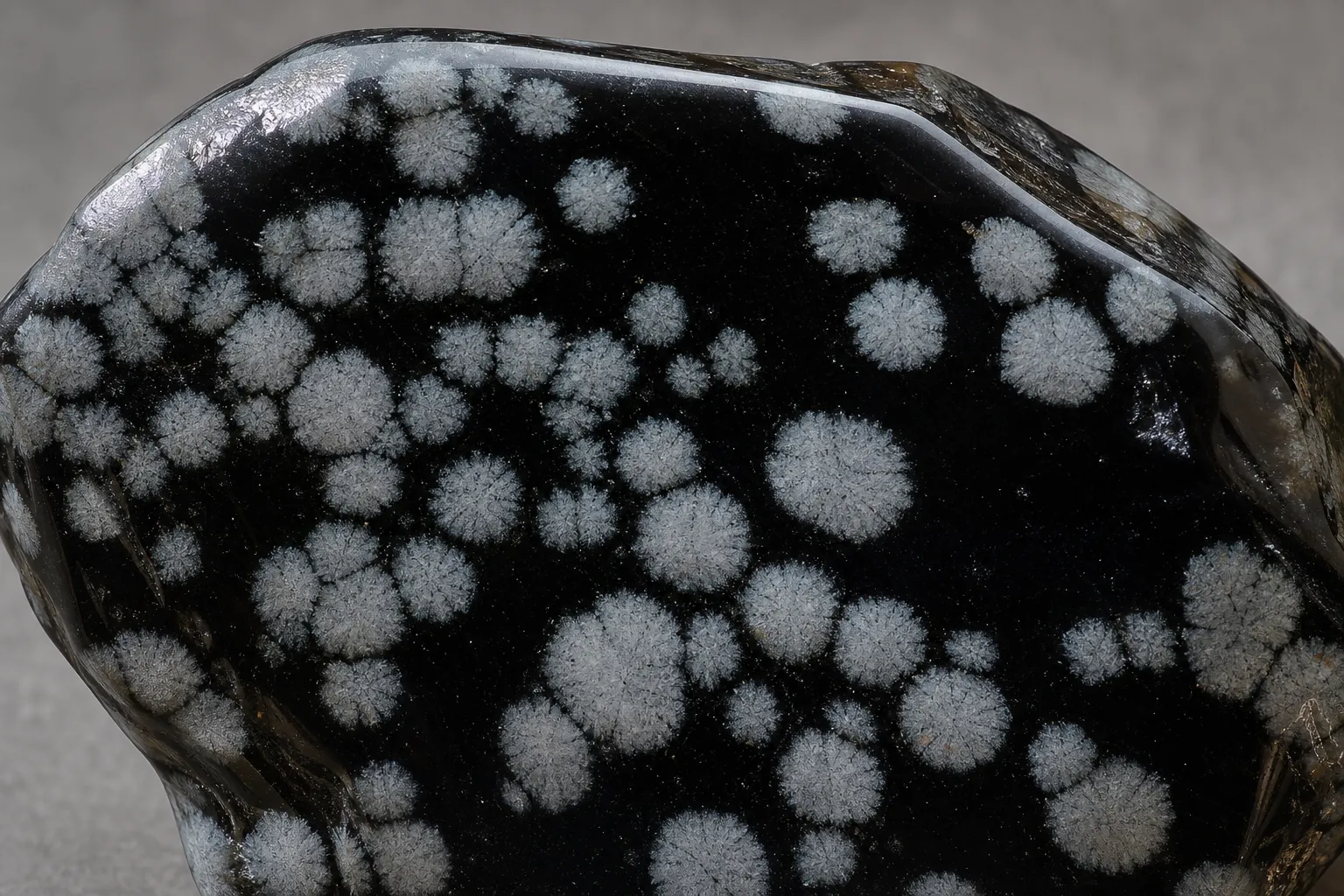
The white spots in obsidian sold as snowflake obsidian are usually internal crystal-growth patterns inside black volcanic glass. Mineral descriptions commonly identify these pale marks as spherulitic cristobalite: rounded or radiating clusters of a silica mineral that developed as the glass partly crystallized.
That is the useful first answer. The spots are not usually dirt, polish residue, or paint sitting on the surface. They are part of the stone’s texture.
They are still only one clue. Snowflake obsidian white spots can look bright white, gray-white, cream-toned, sharp, cloudy, sparse, or crowded. A single photo, seller label, or color tone cannot confirm exactly what a specific piece is.
upward
Read the full overview first
Use the broader guide first if you need the full scope before this page.
Why the White or Gray Spots Form
Obsidian is volcanic glass. It forms when silica-rich lava cools quickly enough that much of the material remains glassy instead of growing large visible crystals. In snowflake obsidian, some of that glass has partly crystallized, creating pale patterns inside the darker body.
Those pale “snowflakes” are usually described as spherulites. A spherulite is a rounded or radiating crystal-growth pattern, not a loose pebble trapped in the glass. In snowflake obsidian, the pattern is commonly linked with cristobalite, a silica mineral form. That is why you may see the marks called white inclusions, grayish-white inclusions, or dull white cristobalite spots.
The process is often called devitrification of volcanic glass. In collector language, that means glass losing some of its glass-only character as tiny crystals develop within it. The whole specimen does not have to become visibly crystalline; partial crystallization can leave a black, glossy base with pale internal patterns.
A casual surface look cannot reconstruct the full formation history of a piece. Petrology sources support the broader mechanism of volcanic glass devitrifying and forming spherulitic textures, but they do not make every pale mark diagnosable by eye. For a collector, the grounded takeaway is simpler: the classic snowflake pattern is an internal crystalline pattern in black volcanic glass, not a surface stain.
What the Spots Can Look Like
Snowflake obsidian does not have one fixed pattern. Some pieces show crisp, star-like clusters. Others show rounded blooms, cloudy gray patches, or broken-looking bursts that only loosely resemble snowflakes. The word “snowflake” is a variety name and visual shorthand, not a promise of perfect symmetry.
Common appearances include
- Small white or gray spots scattered through a glossy black base.
- Larger rounded patches that look more like flowers than flakes.
- Grayish-white inclusions with soft edges rather than sharp points.
- Creamier pale marks under warm indoor lighting.
- Duller pale areas beside highly polished black glass.
- Dense clusters that make the surface look mottled.
Lighting changes the reading. A polished black surface reflects strongly, while pale spherulitic areas may appear flatter or chalkier. On a curved bead or cabochon, glare can make spots look brighter, washed out, or less defined. On rough material, the same inclusions may look dull and irregular because the surface has not been polished.
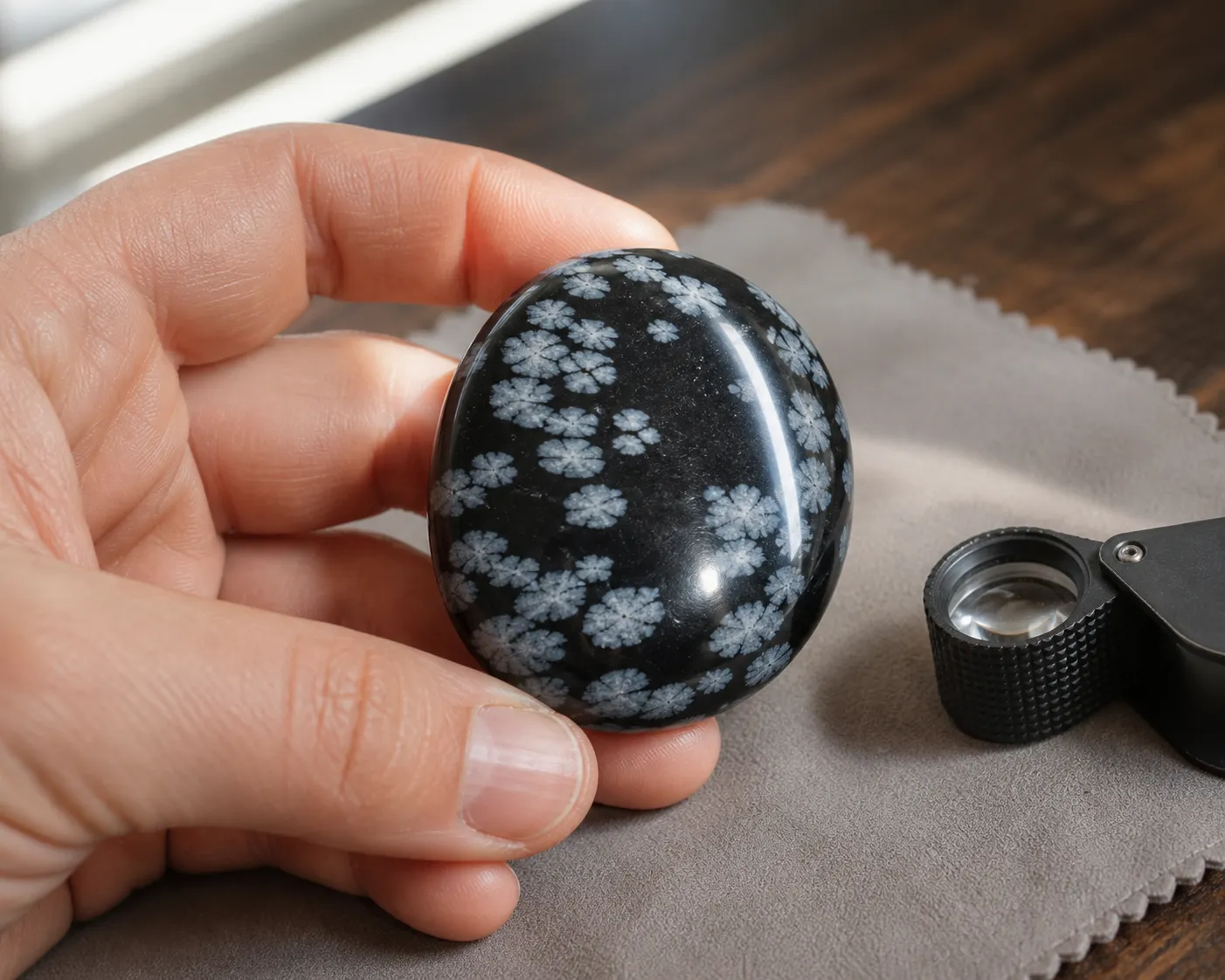
Scale matters too. A small bead may show only one partial spot, so the “snowflake” look can be hard to read. A larger palmstone, slab, or tumbled piece may show many clusters and make the variety name easier to understand. Neither view alone proves or rejects the material.
Look for pale internal patterns distributed through a black glassy body. Do not demand perfect flakes.
What the White Spots Can and Cannot Prove
The spots can support a snowflake obsidian label when they fit the expected visual pattern: black glassy material with white or gray spherulitic markings. They can also explain why a piece looks spotted rather than plain black.
The spots cannot prove a source location, market value, treatment history, or full authenticity from a photo alone. Lighting, polish, cropping, and seller wording all affect what the viewer sees.
Color tone is not enough
Bright white, gray-white, warm white, and dull white can all appear in collector descriptions of snowflake obsidian. A slightly creamier or grayer inclusion is not, by itself, a disqualifying feature.
Shape is not enough
Some snowflake-like crystal patterns are sharp and radiating; others are rounded, clouded, or cut through at the surface. A mark that is not “snowflake-like enough” may be an incomplete spherulite, but it could also be a different pale mark. Shape is a clue, not a verdict.
The seller label is not enough
Market names such as snowflake obsidian, white snowflake obsidian, or gray snowflake obsidian are used in commerce, but a listing name does not replace inspection. If a piece is unusual, expensive, or being bought as a serious specimen, ask for clearer photos, available origin information, or an independent gem or mineral assessment.
For most hobby pieces, close observation is the practical next step. For high-stakes buying, visual clues alone are too thin.
When White Marks Are Not the Snowflake Pattern
Not every pale mark on black obsidian should be read as snowflake obsidian. That is one of the easiest misunderstandings around white spots in obsidian.
Surface residue can sit in pits, cracks, drill holes, or carving details. Polish compound, dust, wax, or ordinary dirt tends to collect along low areas and edges rather than appearing as repeated internal clusters. If a pale mark follows a scratch, seam, or drilled channel, inspect it under strong light before treating it as an inclusion.
Damage can also confuse the eye. A chipped fracture edge may look gray or pale because broken glass scatters light differently from a polished surface. Obsidian commonly breaks with curved, glass-like fracture surfaces, and fresh chips can be sharp. A pale chip on an edge is not the same cue as a rounded internal snowflake pattern.
Other obsidian varieties add another layer. A piece sold as rainbow, gold sheen, or plain black obsidian may show pale inclusions or cloudy spots that are not the main snowflake pattern. Those are comparison cases, not a reason to rename every spotted piece as snowflake obsidian.
A quick inspection route helps
- Check whether the mark looks embedded below the polish or sitting on top.
- Look for repeated rounded or radiating clusters, not one random pale scrape.
- Rotate the piece under light to separate glare from actual inclusion color.
- Inspect chips and drilled areas separately from the main polished face.
- Keep unusual or suspicious pieces uncertain until examined more closely.
Name what you can see before naming the variety.
Care and Handling Around Spotted Obsidian
The white or gray spots do not need special cleaning. For a polished snowflake obsidian piece, gentle handling and simple surface cleaning are usually enough: wipe dust with a soft cloth, avoid hard knocks, and do not scrub the pale areas as if they are surface dirt.
Do not try to grind out, sand away, or “clean off” the spots as a home correction. If the markings are spherulitic cristobalite patterns inside the glass, removing them means removing stone material. Cutting, grinding, or polishing obsidian is lapidary work and calls for suitable tools, wet methods, dust control, and respiratory precautions.
Broken obsidian deserves extra attention. Because it is glassy, chipped edges can be very sharp. If a piece has a fresh fracture, handle the edge carefully, store it where it will not scratch other stones, and keep loose chips out of display trays.
The spots are a visual feature, not a care problem.
A Note on Symbolic Meaning
Snowflake obsidian is often discussed in crystal shops and symbolic settings. You may see the white spots described as representing balance, contrast, insight, or personal change. Those are cultural, spiritual, or personal interpretations attached to the stone; they are not the mineral explanation for the marks.
For identification, stay with the physical cue: black volcanic glass with pale internal crystalline patterns. Symbolic meaning can be part of how someone relates to a piece, but it should not be used to confirm the material or promise an outcome.
The Practical Collector Answer
In snowflake obsidian, the white or gray spots are typically spherulitic cristobalite crystal patterns formed through partial crystallization within volcanic glass. They may look like snowflakes, clouds, blooms, or dull pale patches depending on cut, polish, lighting, and spot density.
Use the spots as a strong visual clue for the variety, not complete proof. Look for internal, repeated, snowflake-like patterns in a black glassy base; separate those from residue, chips, glare, and seller wording. If the piece matters beyond casual collecting, visual inspection is only the beginning.