
Volcanic glass formation
Why Does Obsidian Form as Glass Instead of Crystals
Obsidian forms as glass because volcanic melt becomes rigid before visible mineral crystals have enough time and mobility to nucleate and grow. The short answer to why does obsidian form as glass is not that lava “turns into glass” in a magical instant. It is that a silica-rich volcanic melt can pass into a glassy state while its atoms remain mostly disordered instead of arranging into large, repeating crystal structures.
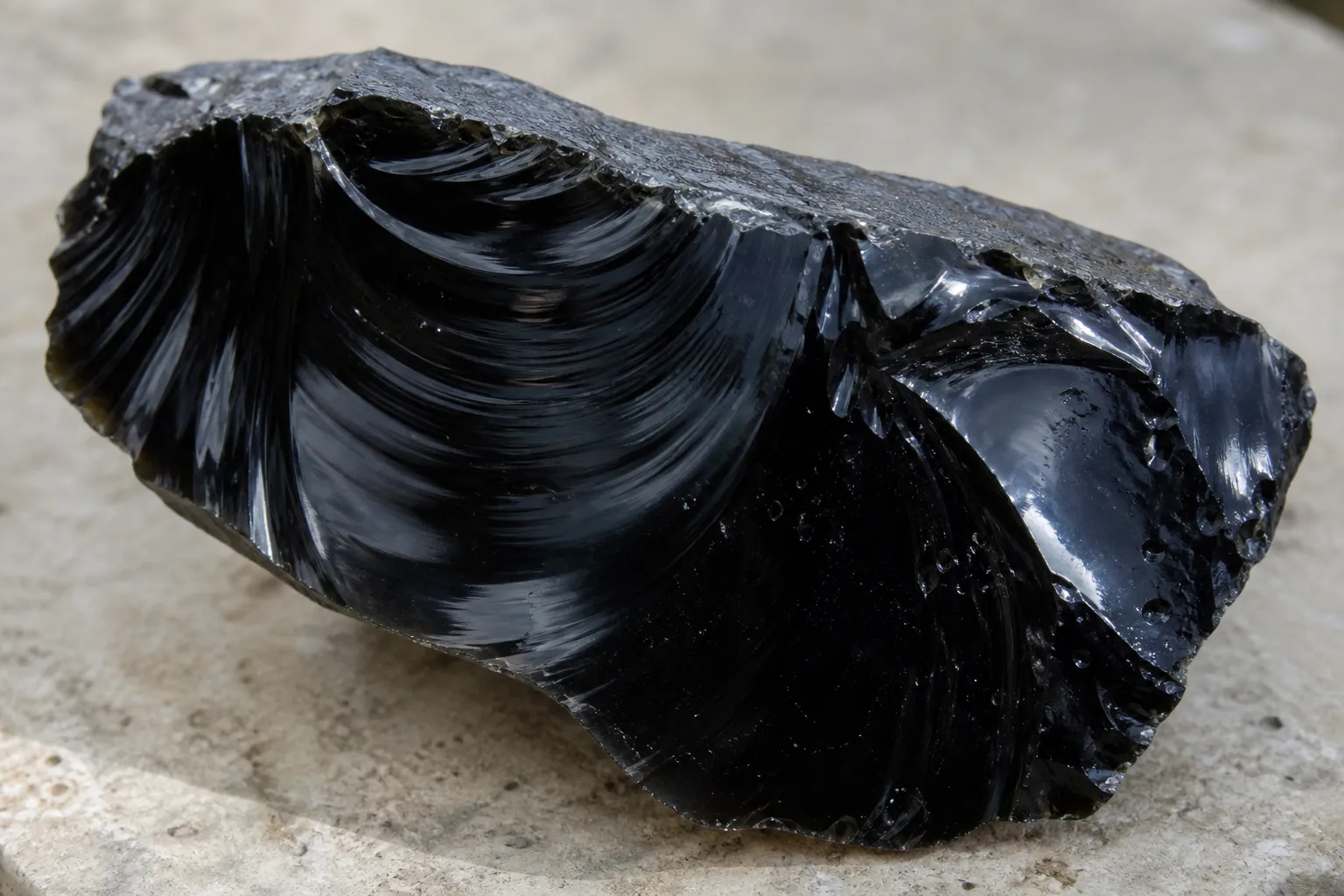
That is why a typical hand specimen looks smooth, shiny, and black or dark-colored rather than grainy like granite or visibly crystalline like quartz. The common phrase “rapid cooling” is useful, but it needs careful wording: rapid means fast compared with crystal growth, not necessarily instant freezing.
Core answer
Obsidian glass formation happens when silica-rich volcanic melt becomes rigid before crystal nucleation and growth can build ordinary visible mineral crystals.
upward
Read the full overview first
Use the broader guide first if you need the full scope before this page.
The basic mechanism: the melt locks up before crystals take over
A crystal is not just a shiny stone. In geology, a crystal has an ordered internal structure, with atoms or ions arranged in a repeating pattern. For crystals to develop in cooling lava, two steps have to happen:
- tiny ordered starting points must form, called crystal nucleation;
- those starting points must enlarge through crystal growth.
If those steps continue long enough, the cooled rock can develop visible mineral grains. Obsidian follows a different route. It solidifies while much of the internal structure remains disordered. That disordered solid is glass.
In geological terms, obsidian is an amorphous volcanic glass. “Amorphous” means it lacks the long-range atomic order that defines a true crystal.
For a collector, that formation history helps explain several visible traits:
- glassy or vitreous luster;
- smooth-looking polished or broken surfaces;
- few or no visible mineral grains in ordinary black obsidian;
- curved, shell-like breakage called conchoidal fracture;
- very sharp broken edges, because glassy materials can fracture cleanly.
Those features do not prove that every black shiny stone is obsidian. Slag, manufactured glass, and other dark rocks can confuse beginners. But the traits fit the reason obsidian behaves more like natural glass than like a visibly crystalline rock.
Why silica-rich melt makes glass formation more likely
Obsidian is commonly associated with silica-rich volcanic systems, especially rhyolitic compositions. Silica-rich melt is usually very viscous. In plain language, it is thick and resistant to flow compared with more fluid lava.
That viscosity matters because crystal formation requires movement at a tiny scale. Atoms and ions must shift into stable, ordered positions. In a thick silicic melt, that rearrangement can be slow. If the melt becomes rigid before ordering gets far enough, the result is obsidian without visible crystals.
So crystal growth in lava is not controlled by cooling speed alone. Composition, viscosity, water content, bubbles, and available crystal “seeds” can all influence the final texture.
Obsidian glass formation happens when silica-rich volcanic melt becomes rigid before crystal nucleation and growth can build ordinary visible mineral crystals.
That is the core answer. The details mainly refine what “rapid cooling” really means.
“Rapid cooling” does not always mean an instant event
Many beginner explanations say obsidian forms when lava cools rapidly. That is a fair first pass, but it can create the wrong picture.
It does not mean every piece of obsidian formed in a dramatic instant when lava touched water. It does not mean all lava-water contact makes obsidian. It also does not mean the cooling had to be fast in an everyday sense, like a hot pan dropped into cold water.
The better wording is: obsidian cools or solidifies quickly enough relative to the rate of crystal growth.
The race is between ordering and locking. If the melt has enough mobility and time, crystals can form. If the structure becomes rigid first, the disordered glass remains.
A simple analogy is a crowd trying to line up in rows while the room is becoming too packed to move. If people organize early, you get neat rows. If movement stops before the rows form, the arrangement stays disordered. Obsidian is closer to that locked, disordered pattern: natural, volcanic, and glassy.
Dense obsidian adds one more wrinkle: bubbles
The glass-versus-crystal question is mainly about crystal growth. But many obsidian pieces raise a second question: why are they dense and smooth instead of frothy like pumice?
This is where the simple rapid-cooling explanation becomes incomplete. Some research on obsidian-forming systems suggests that dense, low-bubble obsidian may require enough time for bubbles to shrink, dissolve back into the melt, or otherwise fail to remain as open cavities before the material fully locks as glass.
This is often discussed as bubble resorption. In silica-rich melt, water and other volatiles may exist dissolved in the melt or as gas bubbles. Under some conditions, vapor in bubbles can dissolve back into the melt, reducing the number or size of preserved bubbles.
For a beginner, the useful distinction is:
Why does obsidian look glassy instead of crystalline?
The melt became rigid before visible crystals could grow.
Why is some obsidian dense instead of frothy?
Bubbles may have escaped, shrunk, or resorbed before the glass fully solidified.
These are related parts of the same volcanic story, but they are not identical. Dense, bubble-poor obsidian did not necessarily form by instant freezing. It may reflect a balance: enough time or conditions for bubbles to diminish, but not enough successful crystal growth to turn the material into a visibly crystalline rock.
Why some obsidian still has patterns or “snowflakes”
If obsidian is glass, why do some pieces show pale spots, bands, shimmer, or other patterns?
Because volcanic glass does not have to be perfectly uniform at every scale. Obsidian can contain flow bands, microscopic crystals, nanoscopic crystallites, bubbles, inclusions, or later devitrification textures. Some are too small to see. Others create visible patterns.
Snowflake obsidian is the easiest collector example. Its gray-white “snowflakes” are commonly understood as crystalline or spherulitic textures within a darker glassy base. The piece can still be discussed as obsidian because much of the material is volcanic glass, even though it contains visible patterned areas.
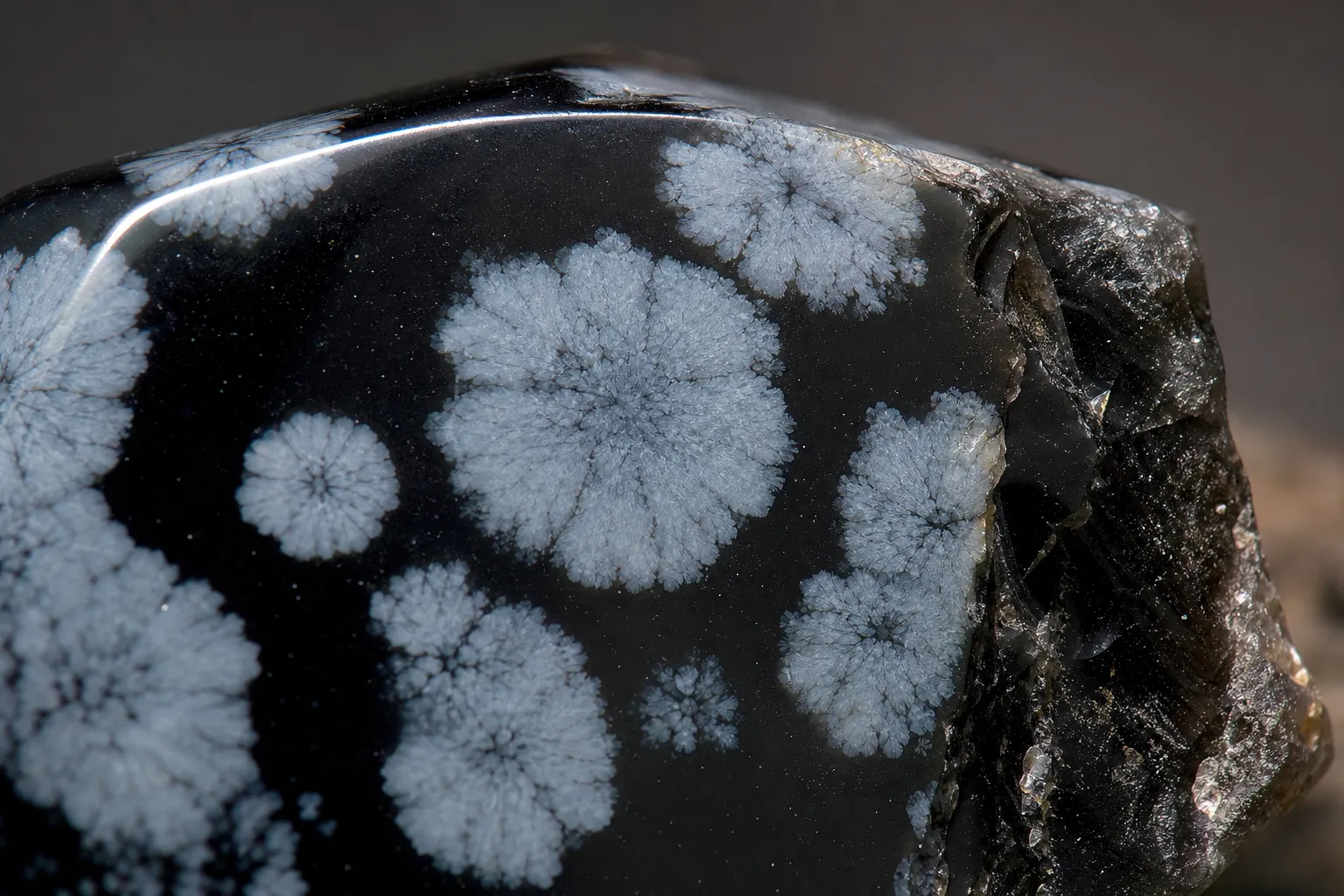
Other varieties may show sheen, color differences, or banding. These effects can depend on tiny inclusions, internal textures, lighting, polish quality, and seller naming habits. A pattern does not automatically mean the whole stone is a conventional crystal. It means the glassy material has added texture or inclusions that affect what you see.
This is also why the phrase “obsidian crystal” can be confusing. In retail and collecting language, “crystal” is often used broadly for stones, polished pieces, and display specimens. In geology, obsidian is better described as natural volcanic glass rather than a true mineral crystal with a repeating atomic lattice.
What the formation story helps you observe
You cannot reconstruct the full cooling history of a specimen just by holding it. Still, the formation story gives you a better way to look.
Glassy shine
A glassy texture rather than visible grains.
Smooth dark body
Fine-scale or amorphous structure with few obvious crystals.
Curved fracture surfaces
Conchoidal fracture, common in glassy materials.
Dense, compact feel
Few visible vesicles, though weight alone is not identification.
Flow bands or streaks
Movement and variation in the melt before or during solidification.
Pale “snowflake” spots
Crystalline or devitrification textures within glassy obsidian.
These observations are useful, but they are not a complete authentication method. Formation facts explain why obsidian often looks the way it does; they do not make a photo, color, shine, or single fracture surface a certain identification.
If a piece is broken, handle the edge as you would broken glass. The caution is simply physical: fresh obsidian fractures can be sharp.
Common misunderstandings about obsidian glass formation
“Obsidian forms instantly when lava touches water.”
Water can cool lava quickly, but obsidian is not simply “any lava plus water.” Composition and crystallization conditions matter. Obsidian is usually tied to silica-rich volcanic melt, not every lava-water contact.
“If it has no visible crystals, it is not a real rock.”
Obsidian is a natural volcanic material. It is commonly described as volcanic glass because of its amorphous structure, but that does not make it artificial.
“Glass means nothing inside is ordered at any scale.”
Collector-level obsidian may look glassy and lack visible mineral grains, but some samples can contain microlites, nanolites, bands, or devitrification textures. The practical point is that the main body did not develop ordinary visible crystals before becoming glass.
“Dense obsidian proves sudden cooling.”
Not by itself. Dense, bubble-poor obsidian may reflect bubble loss or bubble resorption as well as cooling. Density alone does not prove an instant formation event.
“All black shiny stones are obsidian.”
No. Glassy luster is a clue, not a final answer. Color, fracture, texture, context, and sometimes testing are needed when identification matters.
The short answer to keep
Obsidian forms as glass instead of visible crystals because volcanic melt becomes rigid before crystal nucleation and growth can build ordinary mineral grains. Silica-rich melt is viscous, so atomic rearrangement can be slow. Cooling only has to be fast relative to that crystal-forming process, not necessarily instantaneous.
Dense obsidian adds one more nuance: some low-bubble textures may involve bubbles shrinking, escaping, or dissolving back into the melt before the glass fully solidifies. That helps explain why a piece may look compact rather than frothy, but it does not replace the main reason obsidian is amorphous volcanic glass.
For collectors, the answer shows up in the object itself: glassy luster, smooth surfaces, conchoidal fracture, few visible crystal faces, and sometimes bands or patterned inclusions inside a natural volcanic glass.